Archive | Afghanistan

Reporter Asks White House if U.S. Airstrikes That Kill Afghan Civilians Qualify as ‘Terrorism’

NOVANEWS
by Rania Khalek

UPDATE: The reporter who asked the question is Amina Ismail, a journalist at McClatchy. I urge you to thank her for asking it (her twitter handle is @AminaIsmail) because I can’t imagine it was easy given how extremely rare and frowned upon it is to challenge the dominant “war on terror” narrative, especially as a female reporter with an Arab-sounding name. And Amina, if you’re reading this, thanks for kicking ass!

* * * *

Matthew Keys, the social media editor at Reuters, posted audio of a reporter asking White House Press Secretary Jay Carney if U.S. bombings that kill innocent civilians in Afghanistan constitute an “act of terror” given the labeling of the Boston Marathon bombing as “terrorism”. She specifically refers to a U.S. airstrike earlier this month that killed 11 children, just the latest in a seemingly endless line of Afghan civilian deaths at the hands of the U.S. government.

Carney completely dodged the questions, pointing instead to the 9/11 terrorist attacks to justify U.S. bombings in Afghanistan. After a long-winded answer excusing U.S. conduct, Carney concludes, “ we take great care in the prosecution of this war.”

Tell me, does this look like “great care” to you?

The lifeless bodies of Afghan children lay on the ground before their funeral ceremony, after a NATO airstrike killed several Afghan civilians, including ten children during a fierce gun battle with Taliban militants in Shultan, Shigal district, Kunar, eastern Afghanistan, Sunday, April 7, 2013. (AP Photo/Naimatullah Karyab)

I transcribed the exchange in full:

REPORTER: I send my deepest condolence to the victims and families in Boston. But President Obama said that what happened in Boston was an act of terrorism. I would like to ask, Do you consider the U.S. bombing on civilians in Afghanistan earlier this month that left 11 children and a woman killed a form of terrorism? Why or why not?

JAY CARNEY: Well, I would have to know more about the incident and then obviously the Department of Defense would have answers to your questions on this matter. We have more than 60,000 U.S. troops involved in a war in Afghanistan, a war that began when the United States was attacked, in an attack that was organized on the soil of Afghanistan by al Qaeda, by Osama bin laden and others and more than 3,000 people were killed in that attack. And it has been the President’s objective once he took office to make clear what our goals are in Afghanistan and that is to disrupt, dismantle and ultimately defeat al Qaeda. And with that as our objective to provide enough assistance to Afghan National Security Forces and the Afghan government to allow them to take over security for themselves. And that process is underway and the United States has withdrawn a substantial number of troops and we are in the process of drowning down further as we hand over security lead to Afghan forces. And it is certainly the case that I refer you to the defense department for details that we take great care in the prosecution of this war and we are very mindful of what our objectives are.

At the very least, this serves as another example of the utter meaninglessness of the word “terrorism”.

Posted in Afghanistan, USA0 Comments

‘Karzai should call on US forces to leave’

NOVANEWS

Co-founder of Crescent and Cross Solidarity Movement says Afghan President Hamid Karzai should call on U.S.-led foreign forces to leave Afghanistan.

“The Americans and the other NATO countries would not be in his (Karzai’s) country killing these Afghans, not just Afghan children, but Afghan men and women as well, for the fact that he has surrendered the sovereignty of his country to these foreign powers … these acts would not have taken place, not for the fact he has allowed these murderous armies to come in and to kill his own people”.

So Mr. Karzai, if you want to see your people delivered from this terrible scourge of Western military intervention then all you need to do is to tell them [U.S.-led foreign forces] to leave and then begin forming alliances with other powerful countries in the region”, Mark Glenn said in a phone interview with Press TV’s U.S. Desk on Sunday.

On Saturday, Karzai lambasted U.S.-led foreign forces for excessive force after an airstrike by the U.S. military left 17 civilians dead.

Karzai’s comment comes after an investigation boosted the civilian death toll in the April 6 incident upwards from 11. The new toll of 17 includes 12 children, four women and a man, all killed in Shigal district of Kunar province.

Karzai laid the blame for the deaths at the feet of the U.S. military, but also condemned the use of civilians and their homes as shields by the Taliban militants.

Posted in Afghanistan0 Comments

From Afghanistan to Syria: Women’s Rights, War Propaganda and the CIA

NOVANEWS
Global Research

Women’s rights are increasingly heralded as a useful propaganda device to further imperial designs.

Western heads of state, UN officials and military spokespersons will invariably praise the humanitarian dimension of the October 2001 US-NATO led invasion of Afghanistan, which allegedly was to fight religious fundamentalists, help little girls go to school, liberate women subjected to the yoke of the Taliban.

The logic of such a humanitarian dimension of the Afghan war is questionable. Lest we forget, Al Qaeda and the Taliban were supported from the very outset of the Soviet-Afghan war by the US, as part of a CIA led covert operation.

As described by the Revolutionary Association of the Women of Afghanistan (RAWA):

The US and her allies tried to legitimize their military occupation of Afghanistan under the banner of “bringing freedom and democracy for Afghan people”. But as we have experienced in the past three decades, in regard to the fate of our people, the US government first of all considers her own political and economic interests and has empowered and equipped the most traitorous, anti-democratic, misogynist and corrupt fundamentalist gangs in Afghanistan.

It was the US which installed the Taliban regime in Afghanistan in 1996, a foreign policy strategy which resulted in the demise of Afghan women’s rights:

Under NSDD 166, US assistance to the Islamic brigades channelled through Pakistan was not limited to bona fide military aid. Washington also supported and financed by the U.S. Agency for International Development (USAID), the process of religious indoctrination, largely to secure the demise of secular institutions. (Michel Chossudovsky, 9/11 ANALYSIS: From Ronald Reagan and the Soviet-Afghan War to George W Bush and September 11, 2001, Global Research, September 09, 2010)

Religious schools were generously funded by the United States of America:

Education in Afghanistan in the years preceding the Soviet-Afghan war was largely secular. The US covert education destroyed secular education. The number of CIA sponsored religious schools (madrassas) increased from 2,500 in 1980 to over 39,000 [in 2001]. (Ibid.)

Afghan women.(AFP Photo / Shah Marai)

Afghan women now. (AFP Photo / Shah Marai)

Afghan women in the 1970s before the CIA-led intervention

Unknown to the American public, the US spread the teachings of the Islamic jihad in textbooks “Made in America” developed at the University of Nebraska:

… the United States spent millions of dollars to supply Afghan schoolchildren with textbooks filled with violent images and militant Islamic teachings, part of covert attempts to spur resistance to the Soviet occupation.

The primers, which were filled with talk of jihad and featured drawings of guns, bullets, soldiers and mines, have served since then as the Afghan school system’s core curriculum. Even the Taliban used the American-produced books…

The White House defends the religious content, saying that Islamic principles permeate Afghan culture and that the books “are fully in compliance with US law and policy.” Legal experts, however, question whether the books violate a constitutional ban on using tax dollars to promote religion.

… AID officials said in interviews that they left the Islamic materials intact because they feared Afghan educators would reject books lacking a strong dose of Muslim thought. The agency removed its logo and any mention of the U.S. government from the religious texts, AID spokeswoman Kathryn Stratos said.

“It’s not AID’s policy to support religious instruction,” Stratos said. “But we went ahead with this project because the primary purpose . . . is to educate children, which is predominantly a secular activity.”

… Published in the dominant Afghan languages of Dari and Pashtun, the textbooks were developed in the early 1980s under an AID grant to the University of Nebraska -Omaha and its Center for Afghanistan Studies. The agency spent $ 51 million on the university’s education programs in Afghanistan from 1984 to 1994.” (Washington Post, 23 March 2002)

Historical Flashback

Before the Taliban came to power, Afghan women lived a life in many ways similar to that of Western women (see pictures below):

Kabul University 1980s

Kabul University 1980s

Kabul University 1980s

In the 1980s, Kabul was “a cosmopolitan city. Artists and hippies flocked to the capital. Women studied agriculture, engineering and business at the city’s university. Afghan women held government jobs.” There were female members of parliament, and women drove cars, and travelled and went on dates, without needing to ask a male guardian for permission.

Ironically, the rights of women as described by RAWA prior to the US sponsored jihadist insurgency is confirmed in a 2010 article published by Foreign Policy (2010), a Washington Post mouthpiece founded by Samuel Huntington:

 Original caption: "Kabul University students changing classes. Enrollment has doubled in last four years." The physical campus of Kabul University, pictured here, does not look very different today. But the people do. In the 1950s and '60s, students wore Western-style clothing; young men and women interacted relatively freely. Today, women cover their heads and much of their bodies, even in Kabul. A half-century later, men and women inhabit much more separate worlds.

“Kabul University students changing classes. Enrollment has doubled in last four years.“

The physical campus of Kabul University, pictured here, does not look very different today. But the people do. In the 1950s and ’60s, students wore Western-style clothing; young men and women interacted relatively freely. Today, women cover their heads and much of their bodies, even in Kabul. A half-century later, men and women inhabit much more separate worlds.

 "Biology class, Kabul University." In the 1950s and '60s, women were able to pursue professional careers in fields such as medicine. Today, schools that educate women are a target for violence, even more so than five or six years ago.

“Biology class, Kabul University.”

In the 1950s and ’60s, women were able to pursue professional careers in fields such as medicine. Today, schools that educate women are a target for violence, even more so than five or six years ago.

 "Phonograph record store." So, too, were record stores, bringing the rhythm and energy of the Western world to Kabul teenagers.

“Phonograph record store.”

So, too, were record stores, bringing the rhythm and energy of the Western world to Kabul teenagers.

"Hundreds of Afghan youngsters take active part in Scout programs."

“Hundreds of Afghan youngsters take active part in Scout programs.”

Afghanistan once had Boy Scouts and Girl Scouts. In the 1950s and ’60s, such programs were very similar to their counterparts in the United States, with students in elementary and middle schools learning about nature trails, camping, and public safety. But scouting troops disappeared entirely after the Soviet invasions in the late 1970s. (Mohammad Qayoumi Once Upon a Time in Afghanistan…, Foreign Policy, May 27, 2010)

The acute reader will have noticed the insidious disinformation in the previous caption. We are led to believe that the liberal lifestyle of Afghan women was destroyed by the Soviet Union, when in fact it was the result of US support to Al Qaeda and the Taliban. Acknowledged by US foreign policy Advisor Zbignew Brzezinski, Moscow’s action in support of the Kabul pro-Soviet government was to counter the Islamist Mujahedin insurgency supported covertly by the CIA:

Indeed, it was July 3, 1979 that President Carter signed the first directive for secret aid to the opponents of the pro-Soviet regime in Kabul. And that very day, I wrote a note to the president in which I explained to him that in my opinion this aid was going to induce a Soviet military intervention [...]

That secret operation was an excellent idea. It had the effect of drawing the Russians into the Afghan trap and you want me to regret it? The day that the Soviets officially crossed the border, I wrote to President Carter. We now have the opportunity of giving to the USSR its Vietnam war. (The CIA’s Intervention in Afghanistan, Nouvel Observateur, 1998, Global Research, October 15, 2001)

In 1982, President Ronald Reagan even dedicated the space shuttle Columbia to the US supported Islamist freedom fighters in Afghanistan, namely Al Qaeda and the Taliban:

Just as Columbia we think represents man’s finest aspirations in the field of science and technology, so too does the struggle of the Afghan people represent man’s highest aspirations for freedom.


Ronald Reagan meeting with the Taliban in 1985: ’”These gentlemen (the Taliban) are the moral equivalents of America’s founding fathers.”

Yet, both the US and the governments of NATO members claim the US-NATO military presence in Afghanistan was instrumental in promoting women’s rights. The fact of the matter is that those rights were abolished by the US-backed Taliban regime which came to power with the support of Washington.

The US State Department’s Syrian Women’s Network

How does the history of women in Afghanistan relate to women’s rights in Syria in the context of the current crisis?

The undeclared US-NATO war on Syria (2011-2013) in support of Al Qaeda affiliated rebels appears to have a similar logic, namely the destruction of secular education and the demise of women’s rights.

Will Syrian women be facing the same grim future as that of Afghan women under the Taliban regime?

Last January, a diverse group of Syrian women said to be representing the leading opposition movements attended a conference hosted by the Women’s Democracy Network (WDN), in coordination with the U.S. Department of State’s Office of Global Women’s Issues in Doha, Qatar.

WDN is an initiative of the International Republican Institute, well-known for supporting dissidents in various countries defying US imperialism. The US State Department is clearly using women’s rights as a tool, while at the same time it is funding an Islamistopposition with a view to undermining the secular state and eventually installing an Islamist government in Damascus.

The Syrian Women’s Network was formed at the US-sponsored conference and a Charter was written to ensure women are included in the conflict resolution and transition of their country:

In the charter, participants call for equal rights and representation for all Syrians, demanding equal participation of women at all international meetings, negotiations, constitution drafting and reconciliation committees and in elected governing bodies. The charter also covers topics including prevention of and prosecution for acts of violence against women, access to education and the overall need for women’s participation in ongoing conflict resolution while ensuring women’s future participation in the rebuilding of Syria. U.S. government leaders also participated in the conference, underscoring their support of the Syrian women [...] In her remarks, Carla Koppell, senior coordinator for Gender Equality and Women’s Empowerment at the United States Agency for International Development [USAID], advised, “If the most diverse group of women can find a common agenda, it will have enormous strength.” (Women Demand Role in Syria’s Transition and Reconciliation, January 28, 2013, emphasis added.)

Monica McWilliams, founder of the Northern Ireland Women’s Coalition (left) and Deputy Prime Minister of Kosovo Edita Tahiri (right) share their experiences with participants of a conference in Doha, Qatar, where Charter of the Syrian Women’s Network was adopted by a diverse group of Syrian women representing the leading opposition movements in the country.(Photo from wdn.org)

Monica McWilliams, founder of the Northern Ireland Women’s Coalition (left) and Deputy Prime Minister of Kosovo Edita Tahiri (right) share their experiences with participants of a conference in Doha, Qatar, where Charter of the Syrian Women’s Network was adopted by a diverse group of Syrian women representing the leading opposition movements in the country.(Photo from wdn.org)

The first striking paradox of this conference is that it is being held in Qatar, a country where women’s rights remain limited, to say the least. In mid-March, the Qatar government even expressed concerns about references to women’s sexual and reproductive rights“ which are contained in the UN Declaration of the Commission on the Status of Women called Elimination and prevention of all forms of violence against women and girls.

Second paradox: USAID, which contributed to the demise of women’s rights by promoting religious indoctrination in Afghanistan, is now promoting women’s rights to bring about regime change in Syria. In the meantime, the US along with Qatar and Saudi Arabia is supporting Islamist extremist groups fighting against the secular Syrian government. Some so-called liberated areas in Syria are now run by religious extremists:

Religious Wahhabi school and women’s rights in a ‘liberated’ area of Aleppo run by the US-Saudi backed ‘opposition’, ‘a definite improvement’ when compared to the prevailing system of secular education in Syria. (Michel Chossudovsky, Syria: Women’s Rights and Islamist Education in a “Liberated” Area of Aleppo, Global Research, March 27, 2013.)


Were a US proxy regime to be installed in Damascus, the rights and liberties of Syrian women might well be following the same“freedom-threatening path” as that of Afghan women under the US-backed Taliban regime and continuing under the US-NATO occupation.

Posted in Afghanistan, Syria, USA0 Comments

Eleven children, one woman dead in NATO air strike

NOVANEWS

obamauzis

Reuters

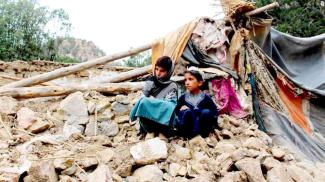
Eleven children and a woman were killed by an air strike during a NATO operation targeting Taliban commanders in eastern Afghanistan, officials in the region said Sunday.

Civilian deaths have been a long-running source of friction between Afghan President Hamid Karzai and his international backers. Karzai has forbidden Afghan troops from calling for air strikes and NATO advise crews not to fire at or bomb in populated areas.

Six insurgents – two of them senior Taliban leaders – were killed during the operation in a village in Shigal district in Kunar province, which is on the Pakistani border, on Saturday, the Interior Ministry said in a statement.

The Interior Ministry did not mention any civilian casualties but Wasefullah Wasefi, a spokesman for the provincial governor, said civilian homes had been hit during an air attack.

“Eleven children and a woman were killed when an air strike hit their houses,” Wasefi said.

The deaths came on the same day that a car bomb killed five Americans, including three U.S. soldiers, a young diplomat and a U.S. Defence Department contractor, in the southern province of Zabul.

Mohammad Zahir Safai, the Shigal district chief, said the woman and the children were killed when the houses collapsed on them.

A spokesman for the NATO-led International Security Assistance Force (ISAF), Captain Luca Carniel, said they were aware of reports of civilian casualties and was assessing the incident.

Carniel said ISAF had provided “air support” during the operation but he said there had been no ISAF troops on the ground. The air strike had been requested by coalition forces, not their Afghan allies, he said.

A Reuters journalist saw bodies of 11 children when they were taken to Safai’s office in protest by their families and other villagers on Sunday.

The journalist did not see the body of a women and Safai said residents told him of the death. Women’s bodies are not displayed, according to custom.

Wasefi also said an American civilian adviser to the Afghan intelligence agency, the National Directorate of Security, had also been killed in the operation. He said it had lasted several hours.

The Ministry of Interior said the two dead Taliban commanders, Ali Khan and Gul Raouf, planned and organised attacks in Kunar

Posted in Afghanistan0 Comments

Nazi NATO airstrike kills two Afghan children

NOVANEWS

NATO Nazi helicopter strike killed two children in southern Afghanistan on Saturday, officials said, in the latest civilian casualties to beset the coalition’s war against Taliban militants.

The operation close to Ghazni city was conducted after local people complained of a Taliban post targeting traffic convoys in the area, Mohammad Ali Ahmadi, the deputy governor of Ghazni province, said.

“It was a joint (Afghan and coalition) operation conducted this morning that killed nine Taliban. Unfortunately, two school children were also killed and seven other civilians were wounded,” he said.

A spokesman for the NATO’s International Security Assistance Force said it was aware of the reported civilian casualties and was seeking further information.

However he added that the ISAF helicopter engagement was not in direct support of Afghan forces, without giving further details.

It was unclear who called in the airstrike, but President Hamid Karzai recently banned Afghan forces from requesting foreign air support.

Civilian casualties mostly caused by air strikes have been one of the most sensitive issues in relations between Karzai and the NATO-led military.

The civilians were riding in two vehicles near the Taliban post when the attack took place, Mohammad Hassan Hadil, the deputy police chief of the province, said.

The deaths, if confirmed, would be another blow to the prestige of US-led NATO forces as they prepare to withdraw combat troops from the war against the Islamist insurgents by the end of next year.

Airstrikes by the US-led coalition killed 126 Afghan civilians last year, a nearly 50 percent drop from the year before, according to a recent UN report.

The overall civilian death toll in 2012 also declined some 12 percent to 2,754, compared with 3,131 the previous year, according to the annual report by the United Nations Mission to Afghanistan.

Four civilians, including a child, were killed in a two-day raid against Taliban insurgents by Afghan and international forces in Logar

Posted in Afghanistan0 Comments

Afghanistan: The Legacy of the British Empire. A Brief History

NOVANEWS
Global Research
afghanmap2

A brief review of the recent history of Afghanistan explains some of the background pertaining to today’s crisis in the country.

To begin with, Afghanistan is a complex place; there are 20 major ethnic groups and more than 50 total, with over 30 languages spoken, although most also speak either Pashtun and/or Dari.

This reflects its geographical position at a cultural crossroads, as well as its mountainous topography, which isolates different ethnic groups from one another. In the 1700s, when Afghanistan was just forming as a nation, two of the world’s major powers of the time were advancing towards it from opposite directions. England was busy conquering India between 1757 and 1857, and Russia was spreading its control east and was on Afghanistan’s border by 1828. This overview will focus on first England’s and then America’s part in shaping modern Afghanistan.

One of the most lucrative products that England exported from its new colony India was opium.1

By 1770 Britain had a monopoly on opium production in India and saw to it that cultivation spread into Afghanistan as well (the boundary between the two was ill-defined until 1893). Anxious to protect their drug trade and concerned the Afghan king Dost Mohammad was too friendly with the Russians, the British sent an expeditionary force of 12,000 soldiers into Afghanistan in 1839 to dethrone him and set up their own hand-picked king, Shah Shoja. They built a garrison in Kabul to help prop him up. However the Afghan populace resisted this occupation, and in the winter of 1842 the British were forced into an attempted retreat back to the east. Within days of leaving Kabul 17,000 British soldiers and support staff lay slaughtered in the snow between Kabul and Jalalabad after a battle with Afghan forces.2

Dost Mohammad returned to power, but the Afghan government did not have the resources to protect its borders, and England soon took control of all Afghan territory between the Indus River and the Hindu Kush, including Baluchistan in 1859, denying Afghanistan access to the sea.3 Still worried about the Russians, England invaded Afghanistan again in 1878; overthrew the standing king and forced the new government to become a British protectorate. England considered slicing up Afghanistan according to what London had determined was the “scientific frontier” of its Indian empire, but settled for an Afghan government over which it retained control of the economy and all foreign policy.4

The British invasions embittered the Afghan people, creating a sense of xenophobia that created powerful resistance to Western-style reforms put forward by Afghan leaders in years to come.

In order to consolidate its gains, England created the Durand Line in 1893, an arbitrary 1500-mile border between “British” India and Afghanistan that made permanent its previous territorial gains and laid claim to the Northwest Frontier Provinces, long considered part of Afghanistan. This boundary was made “permanent” in a 1907 Anglo-Russian convention, without consulting the Afghan government.5

Taking these provinces divided the Pashtun people, who since time immemorial had been considered part of the Afghan homeland, between two separate nations, Afghanistan and India. This created a deep animosity among the Pashtuns that survives in full force today, 120 years later. In fact all Taliban are Pashtuns.

Neither Britain nor Pakistan afterward ever gained full control of the Northwest Provinces, and they later became the source of the Islamic radicalism that spawned both Al Qaeda and the Taliban. It is into the Northwest Provinces that majority of the American drone missiles are fired today. This antipathy has its genesis in the drawing of the Durand Line.

A strongly anti-colonial young King Amanullah ascended to the Afghan throne in 1919, and declared Afghanistan’s independence from Britain’s “protectorate” status in his inaugural speech. He attempted to regain the Pashtun lands east of the hated Durand line by organizing uprisings in the Northwest Provinces and supporting them with Afghan troops. Reacting to this provocation, the British attacked once again, embarking on the third Anglo-Afghan war in eighty years in June 1919. The British suffered early setbacks and responded by bombing Kabul and Jalalabad by air. Neither side had the stomach for a long war, and in August of 1919 a peace treaty was signed which granted Afghanistan full independence, but maintained the status quo of the Durand Line.

Meanwhile Britain’s control over the Pashtun tribal areas remained more of a wish than a reality. Between 1849 an 1900 no less than 42 military operations were conducted that did little more than reconfirm the stubborn independence of the mountain tribes. When Amanullah continued to push for reunification after the 1919 war, Britain responded with a ruthless and bloody effort to pacify the Northwest Territories. In 1920 a five-day battle took place in which two thousand British and Indian troops and four thousand Afghan tribesmen were killed.6

Amanullah himself became a beacon of liberalization in Afghanistan. He attempted drastic changes in the country by reforming the army, abolishing slavery and forced labor, and encouraging the liberation of women. He discouraged the use of the veil and the oppression of women, introduced educational opportunities for females. Britain resented Amanullah, fearing that the liberalization of Afghan society would spread to India and become a threat to British rule there.7 Britain therefore initiated support for conservative and reactionary Islamists in the country to undermine Amanullah’s rule.

In 1924 there was a violent rebellion by conservative Islamists in the border town of Khost which was quelled by the Afghan army. The rebellion was a reaction to Amanullah’s social reforms, particularly public education for girls and greater freedom for women. The Afghan historian Abdul Samad Ghaus wrote in 1988, “Britain was seen as the culprit in the affair, manipulating the tribes against Amanullah in an attempt to bring about his downfall.”8

In 1929 there was a larger rebellion of conservative tribes people, and Amanullah was forced to flee the country. Many historians suspect Britain was behind this uprising as well. In Abdul Ghaus’s view, “Afghans in general remain convinced that the elimination of Amanullah was engineered by the British because he had become….an obstacle to the furtherance of Britain’s interests.”9

The new King , Nadir Shah submitted to Britain’s dictates, including acceptance the Durand Line. Britain launched a ferocious new military campaign in 1930 in another bid to gain control of the Northwest Territories. The offensive went poorly, and Britain was about to lose control of Peshawar to the tribal warriors when it initiated a massive aerial bombardment of civilian Afghans to prevent defeat. MIT professor Noam Chomsky later pointed out that, “Winston Churchill felt that poison gas was jut right for use against ‘uncivilized tribes’ (Kurds and Afghans, particularly),” while the respected British statesman Lloyd George observed that “We insist on reserving the right to bomb niggers.”10

One of the root causes of the enduring animosity between Afghanistan and Pakistan was the seemingly permanent loss of Afghan lands taken by the British, including Baluchistan (with its access to the sea), and the Northwest Territories to Pakistan when that country was created by Britain in 1947. The British excluded the Afghans from the partition negotiations and the partition agreement, which finalized Pakistan’s boundaries—on the Durand Line. In addition to institutionalizing the artificial boundary created in 1893, Britain’s parting act hobbled the Afghan economy, permanently denying Afghanistan its former territory over the Hindu Kush with access to the sea.

In response to the partition agreement, the government of Afghanistan created an independent Pashtunistan movement that called for independence in the Northwest Territories. In reply, Pakistan hardened its position regarding the territories. In 1948 Pakistan greatly increased its military presence there. The action provoked the Afghan King Zahir Shah to renounce the Durand Line and demand the return of its territory. Kabul convened an Afghan tribal assembly (a Loya Jirga) which voted its full support for a separate independence for the tribal areas from Pakistan.

The assembly also authorized the Afghan government to abrogate all of Afghanistan’s treaties with Great Britain regarding the trans-Durand Pashtuns. American involved in Afghanistan began in earnest soon after the end of World War II. In 1950 the top-secret U.S. policy document National Security Directive 68 warned of the Soviet Union’s alleged “design for world domination.”

The U.S. initiated aid projects in Afghanistan starting in 1945. Soviet President Nikita Khrushchev wrote in his memoirs, “It was clear to us that the Americans were penetrating Afghanistan with the obvious purpose of setting up a military base.”11 In fact in 1956 the U.S. built a fairly useless International Airport in Kandahar that was widely seen as a refueling base for U.S. bombers. Wikipedia notes that, “Since the airport was designed as a military base, it is more likely that the United States intended to use it as such in case there was a show-down of war between the United States and former USSR.”12

By the early 1970s the U.S. had decided that the best way counter the Soviet’s “design for world domination” was to support the strict Islamists in Afghanistan, who were opposed to the progressive reforms of the Afghan government. According to Roger Morris, National Security Council staff member, the CIA started to offer covert backing to Islamic radicals as early as 1973.13 In August 1979 a classified State Department Report stated: “the United States larger interests …would be served by the demise of the current Afghan regime, despite whatever setbacks this might mean for future social and economic reforms in Afghanistan.” Fundamentalist Islamists opposed to the Afghan government and supported by the U.S. became known as Mujahideen, or ‘fighters for Islam.’

Zbigniew Brzezinski, National Security Advisor to President Carter, admitted after the Soviet-Afghan war that the CIA was providing covert aid to Afghan Mujahideen fully six months before the Soviet invasion.14 He pointed out that the U.S. intention in providing this aid was to “draw the Russians into the Afghan trap….the day the Soviets officially crossed the border, I wrote to President Carter: We now have the opportunity of giving to the USSR its Vietnam War.” The Soviet’s invasion of Afghanistan in December of 1979 was in their minds based largely on the knowledge that the U.S. was purposely destabilizing the Afghan government for its own purposes.

When the Soviets did invade, the U.S. was quick to provide weapons to the Mujahideen. By February 1980, the Washington Post reported that they were receiving arms coming from the U.S. government. The amounts were significant: 10,000 tons of arms and ammunition in 1983 which rose to 65,000 tons annually by 1987, according to Mohammad Yousaf, the Pakistani general who supervised the covert war from 1983-87. Milton Bearden, CIA station chief in Pakistan from 1986-1989 who was responsible for arming the Mujahideen, commented, “The U.S. was fighting the Soviets to the last Afghan.”15

It is estimated that the U.S. and Saudi Arabia gave $40 billion worth of weapons and money to the fundamentalist Mujahideen over the course of the war.16 The money was funneled through the Pakistan government, which used some of it to set up thousands of fundamentalist Islamic religious schools (madrassas) for the Afghan refugee children flooding into the country; these became the formative institutions for the Taliban.17

Many of the madrassa students and Taliban-to-be were traumatized Afghan war orphans, who were then raised in these all-male schools where they learned a literal interpretation of Islam and the art of war, and not much else. Fifteen years later the U.S. was at war with these same fighters, which it had itself created through its funding of the madrassas and the fundamentalists. The 9/11 attacks on the United States were carried out by the same radical Islamists that the U.S. had nurtured and supported during the Soviet war years.

In 2001, three weeks after the 9/11 attacks, the then prime minister Tony Blair sold the case for war in Afghanistan by insisting that the invasion would destroy the country’s illicit drug trade. In an impassioned speech to the Labor Party, he told his supporters, “The arms the Taliban are buying today are paid for by the lives of young British people buying their drugs on British streets.”

But in fact the Taliban had outlawed the cultivation of poppies in May of 2000, and by the time of the U.S./NATO attack and invasion of Afghanistan the drug trade in Afghanistan had almost completely disappeared.18

As soon as the Taliban were overthrown the growing of poppies and production of heroin and opium surged, such that record amounts are produced almost every year, and Afghanistan has become the world’s primary supplier of these drugs. Production of heroin by Afghan farmers rose between 2001 and 2012 from just 185 tons to a staggering 5,800 tons. Ninety per cent of the heroin sold on Britain’s streets today is made using opium from Afghanistan, and after twelve years of U.S. occupation, heroin and opium now account for about half of Afghanistan’s GDP.19

Well over one million Afghans were killed in the Soviet-Afghan war, along with over four million injured. More than five million refugees fled the country during that war, and two million were internally displaced. 20 400,000 more died in the civil war, and 40,000 have died during the U.S. occupation.21 30 years of war combined with 250 years of manipulation by foreign powers have left Afghanistan one of the poorest and most ecologically damaged countries in the world.22

Civil disobedience is not our problem. Our problem is civil obedience. Our problem is that people all over the world have obeyed the dictates of the leaders of their government and have gone to war, and millions have been killed because of this obedience. Our problem is that people are obedient all over the world in the face of poverty and starvation and stupidity, and war, and cruelty. Our problem is that people are obedient while the jails are full of petty thieves, and all the while the grand thieves are running and robbing the country. That’s our problem. Historian Howard Zinn

Dana Visalli is an ecologist and organic farmer living in Twisp, Washington. Contact him at dana@methownet.com See also Afghanistan, Ecology and the End of War http://www.globalresearch.ca/afghanistan-ecology-and-the-end-of-war/5326749 and US Occupation Forces in Afghanistan: Incompetent, Irreverent, and Irrelevant http://www.globalresearch.ca/american-military-field-operations-us-occupation-forces-in-afghanistan/5327210

Notes

1. http://en.wikipedia.org/wiki/Opium_Wars

2. Invisible History: Afghanistan’s Untold Story, Paul Fitzgerald & Elizabeth Gould, 2009, pg 34

3. Ibid, pg 38

4. Ibid, pg 45

5. Ibid, pg 54

6. Ibid, pg 60

7. Ibid, pg 63

8. Ibid, pg 62

9. Ibid, pg 63

10. Ibid, pg 65 11. Ibid, pg 94

12. http://en.wikipedia.org/wiki/Kandahar_International_Airport

13. http://original.antiwar.com/james-lucas/2010/03/05/americas-nation-destroying-mission-in-afghanistan/

14. Interview with Zbigniew Brezinski”. Le Nouvel Observateur. Jan. 15, 1998

15. Milton Bearden, “ Afghanistan Graveyard of Empires.” Foreign Affairs, November/December 2001.

16. http://en.wikipedia.org/wiki/Foreign_relations_of_Afghanistan

17. http://www.cdi.org/terrorism/afghanistan-history-pr.cfm “Lessons from History: U.S. Policy Towards Afghanistan, 1978-2001.” 5 October 2001

18. http://www.dailymail.co.uk/news/article-2102158/Heroin-production-Afghanistan-RISEN-61.html

19. http://www.unodc.org/pdf/publications/afg_opium_economy_www.pdf

20. http://en.wikipedia.org/wiki/Soviet_war_in_Afghanistan#Destruction_in_Afghanistan 21. http://www.scaruffi.com/politics/massacre.html 22. http://www.globalresearch.ca/afghanistan-ecology-and-the-end-of-war/5326749

Posted in Afghanistan0 Comments

Women’s Rights in Afghanistan, “A Justification for War”

NOVANEWS
Global Research

“The Tony Blair Faith Foundation is … honouring International Women’s Day …” (Tony Blair Faith Foundation, 5th March 2013.)

It was former British Prime Minister Harold Wilson who is attributed with the quote “a week is a long time in politics”, referring to the speedy shifting sands of political priorities.

If a week is a while, approaching twelve years is a millennium.

Remember the deluge of political concern over the subjugation of Afghan women at the time of the October 2001 invasion? The tsunami of documentaries, articles, books on their plight, contributing to the justification of another invasion – actually for $trillions of minerals, a geographically strategic country and a pipeline.

It is salutary to recap a few.

In November 2001 First Lady Laura Bush gave the President’s weekly radio address, stating that the fight against terrorism was: “also a fight for the rights and dignity of (Afghan) women.” The State Department marked her broadcast with an eleven page document on the Taliban’s “war against women.”

Hillary Clinton wrote of: “A post-Taliban” country “where women’s rights are respected …” The then UK Prime Minister Tony Blair talked of aid to Afghanistan being conditional on restoration of rights to women and girls.

General Colin Powell stated: “women’s rights will not be negotiable.”

Eight years later, UK politicians still said publicly that women’s rights were a justification for war. Mark Malloch Brown, former Minister of State in the UK Foreign and Commonwealth Office, with responsibility for Africa, Asia and the UN, subsequently Administrator of the UN Development Programme, said in 2009: “The rights of women was one of the reasons the UK and many in the West threw ourselves into the struggle in Afghanistan. It matters greatly to us and our public opinion.” (Action Aid Report: 7th October 2011.)

In a major speech, the same year, the then Foreign Secretary, David Miliband stated that the UK’s relationship with Afghanistan was a “partnership.” (27th July 2009.)

Fast forward then, to 8th March 2013, International Women’s Day, for which the UN had declared this year’s theme as: “The Gender Agenda Gaining Momentum.”

On the eve of Women’s Day the Kabul Girls’ Boxing Team, who were to participate in various events marking the Day, were refused entry to Britain by the UK Border Agency.

Organisations who had long planned welcomes, events and raised funds for the visit of three remarkable young people, who had overcome the restrictions of the most conservative of Afghan culture, expressed their frustration.

It has to be a supreme irony that it was not the Mullahs in Afghanistan who forced disappointment and curtailment on the team’s movements – but the Mullahs in Whitehall. Ironically, the supreme “Mullah” at the UK Border Agency is woman, the Home Secretary, Theresa May.

On 7th March, the East London Fawcett Society, a branch of the UK’s leading equality campaign, wrote to those involved with the initiative:

“We are very sorry to be sending this email to update you that the three boxers on their way to the UK for Saturday’s event ‘Fighting for Freedom – Afghanistan v UK’ … have been refused entry visas and will thus not be here for the bout with UK rivals on Saturday. This event is now cancelled.

On the eve of International Women’s Day, we are thinking of our inspiring sisters in Afghanistan and around the world ..”.

The UK Border Agency in Delhi had, for the second time, refused entry visas into the UK for Sadaf Rahem, Fahima Mohammad, Shabnam Rahman. The three boxers were on their way to the UK to train and fight as guests of the Foundation Women in Sport to mark International Women’s Day.

The decision was lambasted as “utterly ridiculous’” and “at odds with the ideals of the 2012 ‘Olympic Legacy’ “, which the Department for Culture, Media and Sport announced, would aim to:

• Make Britain and great sporting nation

• Inspire

• Show off London’s multicultural heritage.The young women had, for a second time, to travel all the way to the UK Border Agency in Delhi – history does not relate why it is beyond the UK Embassy in Kabul to issue such visas, avoiding considerable expense to people from a war torn country, where living for most is exceptionally hard.

All requested documentation, identification and a letter of support from the Centre of Peace and Unity, their long term supporters in Afghanistan, were presented – and rejected. The girls had expected to finally have their visas and head for the airport and London. Instead, they dejectedly returned to Kabul.

So much for the aims of the “Olympic Legacy”, including “multicultural heritage.”

Margaret Pope, Founder of Women in Sport, which raised funds for the visit, commented on her “extreme disappointment”, adding: “We are made to believe that avenues, especially here in the UK, are opening up to people such as Sadaf Rahem, Fahima Mohammad and Shabnam Rahman, who are trying to pursue their sporting dreams. There has been much talk of the legacy of the Olympics and rights for women in sport, but today, it is not the case for these women.”

Despite it being made clear to officials that the purpose of the visit to the UK was sport and that the women, who are all students, had financial support from Women In Sport for the duration of their trip, they were refused entry based on being unable to illustrate their financial circumstances in Afghanistan and concerns from the High Commission that they may not return to Afghanistan after their visit to the UK.

Melanie Brown, a former aid worker who has made a documentary, “Fighting for Peace” (i) about the women said: “I know how many challenges they have had to overcome in pursuit of their sport. They have continued boxing in the face of these, reaching excellence and representing their country internationally. However, in the face of (UK) bureaucracy they are powerless. This visa refusal will come as a bitter disappointment to them. They may as well have a big tick box saying are you from Afghanistan? Don’t bother.”

Rahimi, Mohammad and Rahman were also to train with Britain’s first licensed female boxer, Jane Couch, and to attend a charity auction in London to raise money for their gym in Kabul. Couch slammed the decision as: “absolutely unbelievable. They are just trying to make a change.”

The Women in Sport Foundation is down but definitely not out and: “remains committed to bringing them here to the UK this year, fighting for freedom.”

Margaret Pope adds:“One of the justifications for Britain’s military involvement in Afghanistan was to help improve the terrible situation for the country’s women. It is therefore a bitter irony that when there is a clear opportunity to assist some of the bravest, talented and most inspiring young Afghan women, bureaucratic delays are quashing their dreams.”

Melanie Brown states: “Making Afghans who request visas travel to a third country in order to receive them and then wait weeks to hear if they have been successful could cynically be seen as a way of discouraging all those but the very wealthy from visiting the UK..”

She has a point, just a week later, on 14th March, a Guardian headline read (Home Secretary) “Theresa May relaxes immigration rules for senior executives and elite graduates.” (ii)

In September 2010, at the United Nations in New York, Prime Minister David Cameron said: “Let’s be clear, you can’t build strong economies, open societies and inclusive political systems if you lock out women.”

Foreign Secretary William Hague said: “women must not be forgotten …”

Just after the invasion, the then Prime Minister, Tony Blair, said on television “We will not walk away as the outside world has done so many times before.”

Between the former and current Prime Minister, Britain has clearly walked away from Afghan women, slammed the door and locked them out..

Notes

i. http://socialdocumentary.net/exhibit/melanie_brown/1932

ii. http://www.guardian.co.uk/uk/2013/mar/14/relax-immigration-rules-theresa-may

Posted in Afghanistan0 Comments

Afghanistan, Ecology and the End of War

NOVANEWS
Global Research

The United States has spent over $600 billion dollars on its Afghan war effort1, but most of the money has gone to military infrastructure and sophisticated weaponry; little of it has gone to the education of Afghan youth or to addressing the degradation of Afghan land.

The children I am working with had never heard the word ‘ecology.’ They can only conjecture at the species of animals and plants that might co-inhabit their nation, guessing at camels, elephants and lions, all of which are wrong. One student suggested the word ‘snake’, when I asked her if she knew what a snake was, she said that she thought it was “some kind of bug.”

This is one small indicator of the level of ignorance that humanity faces about the physical world that we inhabit and ecological basis of life on earth.

Traveling around Afghanistan, one impression that dominates is the absence of vegetation and the abundance of rocks. It has been estimated that 50% of the country was swathed in forests 2000 years ago2, but today tree cover is reduced to 0.25% of the land.3

The loss is driven by an ancient and growing human population and its attendant herds of domestic sheep, goats, cows and pigs. The removal of a large portion of the biomass from the landscape means far less moisture is transpired into the atmosphere, reducing precipitation. Thus human impacts have initiated a negative feedback loop that has reduced the productive capacity of the Afghanistan’s ecosystems.

The ecological deterioration has reached crisis proportions, as the human population has grown from 10 million to 35 million in the past 50 years, and is projected to reach 82 million by 2050.4 The impoverishment of the land has lead to the deepening impoverishment of the Afghan people, with one quarter of the total population, many of them children, living on less than dollar a day.5

The American response to this basic lack of ecological insight has been a military one; an attempt to eradicate poverty and environmental degradation with a massive influx of bullets and bombs

Our irrational behavior in Afghanistan reflects a pattern that extends well back into history. It is a little known fact for example that the genesis of the Korean War was the U.S. military occupation of the country two days after South Korea declared its independence. Korea’s issues at the time were social and environmental; the U.S. response was to drop 600,000 tons of napalm on North Korea—more than we dropped during the entire Vietnam War6—and another 660,000 tons of explosives, virtually atomizing the human infrastructure and inflicting immeasurable damage to the biological foundations of North Korea’s ecosystems .7

A similar dynamic unfolded in Vietnam at nearly the same time. In September of 1945, Vietnam declared its independence from both the French, who had occupied the country for 100 years, and the Japanese, who invaded during World War II.

The United States responded to this declaration by entering into a protracted war with this impoverished nation of rice farmers, dropping 6 million tons of bombs (far more than we dropped in all of WW II) on Vietnam over the next 20 years, along with igniting 400,000 tons of napalm and spraying 19 million gallons of carcinogenic and teratogentic defoliant on one of the richest tropical rainforests on the planet.7 The spraying program, called Operation Ranch Hand, had a motto, “Only you can prevent forests.” At the same time that we were assaulting Vietnam we carpet-bombed Laos and Cambodia, dropping 3 million tons of bombs and spraying two million gallons of defoliant on these rural, agricultural societies.8

War has become a way of life for the United States. Our country funded the civil wars in Central America in the 1970s and 1980s (Guatemala, El Salvador, Nicaragua), funded the fundamentalist Islamic Mujahideen fighting against the Russians in the 1979-1989 war with Afghanistan, funded both sides in the 1980-1988 Iran-Iraq war, and then in 1990 went back to war ourselves, with Iraq, in Afghanistan from 2001 until the present, war again with Iraq from 2003-2012, and now a covert wars with Pakistan and Yemen. Vietnam veteran Mike Hastie characterizes the United States as “a non-stop killing machine.” This country also maintains a nuclear arsenal of 7000 hydrogen bombs, many times more than enough to destroy the majority of life on earth.

Because American war-making is so persistent and pervasive, and because every bomb that is dropped, whether it be on Korea or Vietnam or Afghanistan, in the end falls on the earth and damages the life-enhancing capacity of the biosphere, the realization slowly dawns that this unending aggression is actually a war against the earth itself. The United States has dropped 15,000,000 tons–that’s 30,000,000,000 (thirty billion) pounds—of bombs on the planet’s ecosystems in the last 60 years, along with 1,000,000 tons of napalm, and at least 20,000,000 gallons of defoliants sprayed on rainforests and crops with the intention of destroying them.7

The irony is that the physical earth and the life-sustaining qualities of the biosphere are the very foundation of human life. The elements that make up the human body are derived from the earth and the atmosphere; the food we eat, the water we drink and the air we breathe are all dependent upon an interrelated web of living organisms. If the earth is the source of our lives, why are we expressing so much violence against it?

We can only speculate. Most male mammals have an inherent urge for power, and humans have an inherent fear of death. The genetically-induced emotions related to these passions may be the subconscious forces that are driving our dysfunctional and self destructive aggressive behavior. There is also a genetically driven proclivity for humans to submit to external authority.

But modern warfare is clearly suicidal. The great paradox of the current drama is that the very people who understand the ecological basis of our existence are spending their entire lives funding and otherwise supporting the psychosis of war and the attendant destruction of the biosphere. The current fear-driven model of endless war makes a mockery of the lives of those who are drawn to live a compassionate and intelligent existence, while in fact find all of their resources being stolen by the alpha males of the dominant paradigm of power and aggression.

Human consciousness has changed dramatically over time; there is no reason to think that this will not continue in the future. One major shift that has already occurred is the locus of the individual’s sense of personal identity, which has transitioned over time from the family to the clan, thence to the village, city-state and nation. Our distant ancestors had no way of knowing that we live on planet earth; now that we do know the recognition is dawning that the earth is the source of our lives and is our true home. Once this reality takes root in the human mind and heart, destruction of the ‘ecos’—the homeland–through modern warfare will be recognized for what it is; as an unimaginably perverse and psychotic act.

Dana Visalli is an ecologist and organic farmer living in Twisp, Washington. He is available for powerpoint presentations on the topics covered in this article in the Pacific Northwest. Contact him atdana@methownet.com

Authors Note:

I am currently spending two weeks teaching biology and ecology at a private school in Kabul to young Afghan students who are being prepared to go to college abroad, in hopes that improved education of youth can improve Afghanistan’s future.

Notes

1. http://www.costofwar.com/

2. A Green History of the World, Clive Ponting

3. http://en.wikipedia.org/wiki/List_of_countries_by_forest_area

4. http://en.wikipedia.org/wiki/Demography_of_Afghanistan & http://www.tradingeconomics.com/afghanistan/population

5. http://www.irinnews.org/Report/86889/In-Brief-Nine-million-Afghans-living-on-less-than-a-dollar-a-day-survey

6. North Korea: Another Country by Bruce Cummings. A detailed discussion of the damage sustained by Korea in the Korean war.

7. http://www.methownaturalist.com/20-War,Ecology&Intelligence.pdf 8. http://www.japanfocus.org/-marilyn-young/3125

Posted in Afghanistan0 Comments

Afghanistan: Atrocity after atrocity, lie after lie

NOVANEWS

Karzai’s ‘orders’ repeatedly ignored

‘President’ meets President

On March 1, a U.S./NATO helicopter gunship killed two Afghan brothers, seven and eight years of age, as they tended cattle in Uruzgan province. According to reports from residents, the boys were listening to a radio, which the helicopter crew interpreted as “radio signals” from Afghan resistance fighters.

The latest killing comes amidst a series of atrocities against civilians that has further enflamed opposition to the ongoing occupation.

On. Feb. 24, Hamid Karzai, the U.S.-installed “president” of Afghanistan, announced that he was demanding the withdrawal of all U.S. Special Forces troops from Wardak province within two weeks. Wardak is a key strategic region and an area of active resistance to the U.S./NATO occupation.

Will NATO commanders pay any more attention to Karzai’s latest “order” than the many earlier ones that NATO forces ignored and Karzai quietly dropped? Not likely.

What prompted Karzai’s latest proclamation was explained in a statement from his office, which read in part: “After a thorough discussion, it became clear that armed individuals named as US special force[s] stationed in Wardak province engage in harassing, annoying, torturing and even murdering innocent people.

“A recent example in the province is an incident in which nine people were disappeared in an operation by this suspicious force and in a separate incident a student was taken away at night from his home, whose tortured body with throat cut was found two days later under a bridge.”

While U.S. commanders predictably denied the accusations, the level of popular anger in Wardak was made clear by street protests and threats by civilian groups to join the armed resistance if U.S. forces were not withdrawn.

On Feb. 26, 500 people marched in protest of the killings. “If the situation remains like this, this province will collapse very soon,” protester Haji Abdul Qadim told the Reuters news service. “People will join the insurgency very soon because of the abuses of these forces.”

In another recent incident brought to international attention on Feb. 26, a Swedish organization that operates health clinics in Afghanistan said that U.S. military forces occupied and damaged one of their clinics in Wardak on Feb. 11.

The Swedish Committee for Afghanistan said in a statement: “Foreign soldiers entered the health facility by force, tied up and blindfolded the guard on duty, and occupied the facility.”

Andreas Stefansson, director of SCA, said that it was the second time one of SCA’s clinics had been occupied by NATO troops. The previous occupation lasted three days. Stefansson said that NATO has promised that such an occupation would not happen again.

“What we are seeking is that they actually live up to what they say,” Stefansson said. (Reuters, Feb. 26)

On Feb. 13, 10 people, including women and children, were killed in a NATO air strike in Kunar province. On June 6, 2012, 18 civilians were killed in a strike in Logar province. The grisly list of “accidental” killings stretches back a decade.

A ‘president’ in name only

These atrocities and the daily abuses that inevitably accompany imperialist occupation are the source of burning anger among the Afghan people. In the eyes of the population, Karzai shares blame with the occupiers for these outrages. Thus, Karzai’s repeated “orders” forbidding Afghan army units from calling in U.S./NATO air support and for U.S. troops to withdraw from Wardak and stop the hated “night raids” on people’s homes.

In reality, the lowest level U.S. commander has greater military authority than does the ‘president’ of the country.

But his proclamations continue to be disregarded by the occupation forces, exposing the actual power relationship in the country. In reality, the lowest level U.S. commander has greater military authority than does the “president” of the country.

Further illuminating both this relationship and the U.S. intention to maintain a dominant role in Afghanistan was a Feb. 3 joint interview with then-Secretary of Defense Leon E. Panetta and chairman of the Joint Chiefs of Staff General Martin Dempsey. Panetta and Dempsey reaffirmed that the United States would sustain a “strategic partnership” with Afghanistan, citing a decision by the NATO heads of state during a 2012 summit meeting in Chicago to maintain a long-term presence in the country despite a drawdown in the number of U.S. ground troops in the country.

“We’re committing to an enduring presence,” Mr. Panetta said on Feb. 3.

“Strategic partnership” and “enduring presence” are more Washington weasel words for continuing colonial domination over Afghanistan.

On Feb. 26, it was revealed that claims of resistance attacks inside the country declining by 7 percent in 2012 were just one more Pentagon lie. The 7 percent figure was posted on the International Security Assistance Force (the official name of the U.S./NATO force in Afghanistan) website in January, to bolster the administration’s “positive track” line about the war.

When the Associated Press made inquiries about the statistics, NATO officials in Kabul immediately backtracked, stated that they had “erred,” and admitted that in fact, there was no decline at all.

Costs of war

Eleven and a half years of U.S./NATO war and occupation have been a disaster for all but a tiny sliver of the Afghan population.

Despite tens of billions of dollars in U.S.-funded “reconstruction aid,” Afghanistan remains one of the very poorest countries on the face of the Earth. The total U.S. budget for the Afghanistan war is over $640 billion and counting. (Center for Strategic and International Studies)

While U.S. and other NATO-country contractors, and elements of the Afghan elite, have become incredibly rich from this “aid,” the Afghan government presently spends a miniscule $46 per year on health care per person. (GlobalHealthFacts.org)

Afghanistan ranks as the worst country in the world for infant mortality, with a shocking 122 infant deaths per 1,000 live births. (CIA World Factbook 2013) By way of comparison, the infant mortality rate is 6 per 1,000 in the U.S. and 4.8 per 1,000 in Cuba. Life expectancy is just 49 years. Afghanistan is listed as 172nd out of 187 countries in the Human Development Index, with the average adult having 3.3 years of schooling.

In addition to the tens of thousands killed and hundreds of thousands wounded in the war, more than 2.7 million Afghans remain external refugees, most in Pakistan and Iran, and 425,000 are internally displaced. (United Nations High Commissioner for Refugees 2012

No amount of lying Pentagon propaganda can hide the reality that the war has been an unmitigated disaster for the Afghan people and for the thousands of dead and tens of thousands of maimed troops sent to kill and die there in the interests of empire.

Posted in Afghanistan0 Comments

The Children Killed by America’s Drones. “Crimes Against Humanity” committed by Barack H. Obama.

NOVANEWS
Global Research,

This is a list of names of innocent children killed by America’s drones

But behind each name there is the face of a child with a family history in a village in a far away country, with a mom and a dad, with brothers and sisters and friends.

Among the list, are infants of 1, 2, 3 and 4 years old.

In some cases brothers and sisters of an entire family are killed.

Four sisters of the Ali Mohammed Nasser family in Yemen were killed. Afrah was 9 years old when she and her three younger sisters Zayda (7 years old) , Hoda (5 years old) and Sheika (4 years old) were struck by an American drone.

Ibrahim, a 13 year old boy of the Abdullah Mokbel Salem Louqye family in Yemen was struck by a US drone, together with his younger brother Asmaa (9 years old) and two younger sisters, Salma (4 years old) and Fatima (3 years old)

These children are innocent. They are not different from our own children.

Their lives were taken away at a very young age as part of a military agenda, which claims to be combating “international terrorism”

These drone attacks are extremely precise. We are not dealing with “collateral damage”.

Drone operators have the ability of viewing from a computer screen their targets well in advance of a strike.

A family home is referred to as a “structure” or a “building” rather than a house. When they target a home with family members, they kill children. And they know that in advance of the drone strike:

“Bryant saw a flash on the screen: the explosion. Parts of the building collapsed. The child had disappeared. Bryant had a sick feeling in his stomach.

“Did we just kill a kid?” he asked the man sitting next to him.

“Yeah, I guess that was a kid,” the pilot replied.

“Was that a kid?” they wrote into a chat window on the monitor.”

The Woes of an American Drone Operator, Spiegel.de, December 14, 2012)

These children were killed on the orders of the US President and Commander in Chief Barack H. Obama.

The commander in chief sets the military agenda and authorizes these killings to proceed.

The killings were quite deliberate. They are categorized as “crimes against humanity” under international law.

Those who ordered these drone killings, including the president of the United States, are war criminals under international law and must be indicted and prosecuted

It should be noted that the drone attacks on civilians have increased dramatically during the Obama presidency (see below).

Pakistan strikes


The List of Names was compiled by The Bureau of Investigative Journalism

CIA Drone Strikes in Pakistan 2004–2013

Total US strikes: 362
Obama strikes: 310 
Total reported killed: 2,629-3,461
Civilians reported killed: 475-891
Children reported killed: 176
Total reported injured: 1,267-1,431

US Covert Action in Yemen 2002–2013

Total confirmed US operations (all): 54-64
Total confirmed US drone strikes: 42-52
Possible extra US operations: 135-157
Possible extra US drone strikes: 77-93
Total reported killed (all): 374-1,112
Total civilians killed (all): 72-177
Children killed (all): 27-37

US Covert Action in Somalia 2007–2013

Total US strikes: 10-23 
Total US drone strikes: 3-9
Total reported killed: 58-170
Civilians reported killed: 11-57
Children reported killed: 1-3

Drone Infographics

This map details the locations of CIA drone strikes in the remote Pakistani tribal areas.

Partial List of Children Killed

PAKISTAN

Name | Age | Gender

Noor Aziz | 8 | male
Abdul Wasit | 17 | male
Noor Syed | 8 | male
Wajid Noor | 9 | male
Syed Wali Shah | 7 | male
Ayeesha | 3 | female
Qari Alamzeb | 14| male
Shoaib | 8 | male
Hayatullah KhaMohammad | 16 | male
Tariq Aziz | 16 | male
Sanaullah Jan | 17 | male
Maezol Khan | 8 | female
Nasir Khan | male
Naeem Khan | male
Naeemullah | male
Mohammad Tahir | 16 | male
Azizul Wahab | 15 | male
Fazal Wahab | 16 | male
Ziauddin | 16 | male
Mohammad Yunus | 16 | male
Fazal Hakim | 19 | male
Ilyas | 13 | male
Sohail | 7 | male
Asadullah | 9 | male
khalilullah | 9 | male
Noor Mohammad | 8 | male
Khalid | 12 | male
Saifullah | 9 | male
Mashooq Jan | 15 | male
Nawab | 17 | male
Sultanat Khan | 16 | male
Ziaur Rahman | 13 | male
Noor Mohammad | 15 | male
Mohammad Yaas Khan | 16 | male
Qari Alamzeb | 14 | male
Ziaur Rahman | 17 | male
Abdullah | 18 | male
Ikramullah Zada | 17 | male
Inayatur Rehman | 16 | male
Shahbuddin | 15 | male
Yahya Khan | 16 |male
Rahatullah |17 | male
Mohammad Salim | 11 | male
Shahjehan | 15 | male
Gul Sher Khan | 15 | male
Bakht Muneer | 14 | male
Numair | 14 | male
Mashooq Khan | 16 | male
Ihsanullah | 16 | male
Luqman | 12 | male
Jannatullah | 13 | male
Ismail | 12 | male
Taseel Khan | 18 | male
Zaheeruddin | 16 | male
Qari Ishaq | 19 | male
Jamshed Khan | 14 | male
Alam Nabi | 11 | male
Qari Abdul Karim | 19 | male
Rahmatullah | 14 | male
Abdus Samad | 17 | male
Siraj | 16 | male
Saeedullah | 17 | male
Abdul Waris | 16 | male
Darvesh | 13 | male
Ameer Said | 15 | male
Shaukat | 14 | male
Inayatur Rahman | 17 | male
Salman | 12 | male
Fazal Wahab | 18 | male
Baacha Rahman | 13 | male
Wali-ur-Rahman | 17 | male
Iftikhar | 17 | male
Inayatullah | 15 | male
Mashooq Khan | 16 | male
Ihsanullah | 16 | male
Luqman | 12 | male
Jannatullah | 13 | male
Ismail | 12 | male
Abdul Waris | 16 | male
Darvesh | 13 | male
Ameer Said | 15 | male
Shaukat | 14 | male
Inayatur Rahman | 17 | male
Adnan | 16 | male
Najibullah | 13 | male
Naeemullah | 17 | male
Hizbullah | 10 | male
Kitab Gul | 12 | male
Wilayat Khan | 11 | male
Zabihullah | 16 | male
Shehzad Gul | 11 | male
Shabir | 15 | male
Qari Sharifullah | 17 | male
Shafiullah | 16 | male
Nimatullah | 14 | male
Shakirullah | 16 | male
Talha | 8 | male

YEMEN

Afrah Ali Mohammed Nasser | 9 | female
Zayda Ali Mohammed Nasser | 7 | female
Hoda Ali Mohammed Nasser | 5 | female
Sheikha Ali Mohammed Nasser | 4 | female
Ibrahim Abdullah Mokbel Salem Louqye | 13 | male
Asmaa Abdullah Mokbel Salem Louqye | 9 | male
Salma Abdullah Mokbel Salem Louqye | 4 | female
Fatima Abdullah Mokbel Salem Louqye | 3 | female
Khadije Ali Mokbel Louqye | 1 | female
Hanaa Ali Mokbel Louqye | 6 | female
Mohammed Ali Mokbel Salem Louqye | 4 | male
Jawass Mokbel Salem Louqye | 15 | female
Maryam Hussein Abdullah Awad | 2 | female
Shafiq Hussein Abdullah Awad | 1 | female
Sheikha Nasser Mahdi Ahmad Bouh | 3 | female
Maha Mohammed Saleh Mohammed | 12 | male
Soumaya Mohammed Saleh Mohammed | 9 | female
Shafika Mohammed Saleh Mohammed | 4 | female
Shafiq Mohammed Saleh Mohammed | 2 | male
Mabrook Mouqbal Al Qadari | 13 | male
Daolah Nasser 10 years | 10 | female
AbedalGhani Mohammed Mabkhout | 12 | male
Abdel- Rahman Anwar al Awlaki | 16 | male
Abdel-Rahman al-Awlaki | 17 | male
Nasser Salim | 19

Posted in Afghanistan, Pakistan & Kashmir, Somalia, USA0 Comments

Join our mailing list

* = required field

Archives