Archive | Iraq

“Liberating Iraqis”, Limb by Limb, Life by Life, Home by Home, Gene by Gene

NOVANEWS
Global Research

“Why should we hear about body bags and deaths … I mean, it’s not relevant, so why should I waste my beautiful mind on something like that …” (Former First Lady, Barbara Bush, Good Morning America, 18th March 2003)

In these days of the tenth anniversary of the illegal invasion and near destruction of Iraq, answers are owed not alone for the dead, but to the cancer stricken, the deformed, to their parents, their siblings and all Iraqis. They were left with a land poisoned by depleted uranium in 1991, the burden ever building over twelve more years of (illegal) US and UK bombings, then the enormity of 2003.

Fallujah’s victims have rightly come under medical and media scrutiny since the US military onslaught of April and November 2004, but throughout Iraq, there have been no reports of areas unaffected.

In context, Dahr Jamail writes from Fallujah, “Official Iraqi government statistics show that, prior to the outbreak of the First Gulf War in 1991, the rate of cancer cases in Iraq was 40 out of 100,000 people. By 1995, it had increased to 800 out of 100,000 people, and, by 2005, it had doubled to at least 1,600 out of 100,000 people. Current estimates show the increasing trend continuing.

“As shocking as these statistics are, due to a lack of adequate documentation, research and reporting of cases, the actual rate of cancer and other diseases is likely to be much higher than even these figures suggest.” He also cites, ” … a dramatic jump in miscarriages and premature births … particularly in areas where heavy US military operations occurred …” as Fallujah.

Jamail cites the study by Dr Chris Busby, Malak Hamdan and Entesar Ariabi: “Cancer, Infant Mortality and Birth-Sex Ration in Fallujah, Iraq 2005-2009.” Of it, Dr Busby’s opinion was that the Fallujah health crisis represented “the highest rate of genetic damage in any population ever studied.”

There were numerous reports during the 2004 April and November-December US assaults on Fallujah of, in addition to DU – three times unanimously designated a weapon of mass destruction by UN Sub-Committees – illegal, experimental chemical weapons and napalm being used in the decimation of this city of about three hundred thousand people.

After the second assault, Dr. Saleh Hussein Iswawi of the Fallujah General Hospital told the BBC, “About sixty to seventy percent of the homes and buildings are completely crushed and damaged, and not ready to inhabit … Of the thirty percent still left standing, I don’t think there is a single one that has not been exposed to some damage.”

Charred bodies and those half eaten by stray dogs littered the streets. One resident, Yasser Sattar said,

“This is the crime of the century. Is this freedom and democracy that they brought to Fallujah?”

What happened in Fallujah was a pogrom.It was by no means the only one.

People leaped into the Euphrates River to put out their burning flesh – it continued to burn in the water. Dead were described as “caramelized.” Other bodies were described as melting, disintegrating, but their clothing staying intact, by doctors who have seen much in Iraq in 1991 and since, but never this.

“All forms of nature were wiped out,” stated the (pro-American) Iraqi Health Minister, Dr. ash-Shaykhli.

In December 2004 and January 2005, respectively, UK MPs Alice Mahon and Harry Cohen asked similar questions of the then Defence Minister Adam Ingram about the use of napalm in Fallujah.

Mr Cohen questioned

” … whether Mark 77 (MK 77) firebombs (napalm) have been used by Coalition forces (a) in Iraq and (b) in or near areas in Iraq where civilians lived; whether this weapon is equivalent to napalm; whether the UK and the US have signed the UN convention banning the use of napalm against civilian targets; and if he will make a statement.”

On the 11th of January, Mr. Ingram replied in writing:

“Firebombs/Napalm, “The United States has confirmed to us that they have not used Mark 77 firebombs, which are essentially napalm canisters, in Iraq at any time. No other Coalition member has Mark 77 firebombs in their inventory. The United Kingdom is bound under Protocol III to the 1980 Convention on Certain Conventional Weapons (CCW) not to use incendiary weapons (which would include napalm) against military targets located within concentrations of civilians.”

“US policy in relation to international conventions is a matter for the US Government, but all of our allies are aware of their obligations under international humanitarian law.”

Ingram sidestepped the question about whether the US had signed the CCW of 1980. The US is a party to the Convention, but did not sign the relevant Protocol.

Kim Phúc, the Vietnam napalm survivor of the unforgettable photograph states,

“Water boils at 100 degrees Celsius (212°F). Napalm generates temperatures of 800 to 1,200 degrees Celsius (1,500-2,200°F).”

Mr Ingram’s faith in US allies’ awareness of their “obligations under international humanitarian law,” and apparently their truthfulness, was misplaced. Napalm was used in Iraq and in Fallujah.

In June 2005, Ingram wrote to Alice Mahon’s successor as MP for West Halifax, Yorkshire, Linda Riordan:

“In December last year, your predecessor asked whether napalm or any similar substance had been used by coalition forces in Iraq either during or since the war. My officials put specific questions to US personnel in Iraq and, based on the assurances they received, I told her that neither had been used. I regret to say that I have since discovered that this is not the case and must now correct the position.

“The US destroyed its remaining stock of Vietnam era napalm in 2001, but according to the reports for 1 Marine Expeditionary Force serving in Iraq in 2003 they used a total of 30 MK 77 weapons in Iraq between 31st March and 2nd April 2003, against military targets away from civilian areas.”

“The MK 77 firebomb does not have the same composition as napalm, although it has similar destructive characteristics. The Pentagon has also told us that owing to the limited accuracy of the MK 77, it is not generally used in urban terrain or in areas where civilians are congregated.”

A quick check shows that in fact, the MK 77 – weighing seven hundred and fifty pounds “is the direct successor to napalm … the mixture also contains an oxidizing agent, making it more difficult to put out once ignited, as well as (containing) white phosphorous.”

“Napalm by another name,” commented the Sydney Morning Herald (the 9th of August 2003). The Director of the military studies group Global Security stated, ” You can call it something other than napalm, but it is still napalm. It has been reformulated in the sense that they now use a different petroleum distillate, but that is it. The US is the only country that has used napalm for a long time.”

The US also admits to dropping five hundred of these human being incinerating weapons of mass destruction in Iraq in 1991.

Also used in Fallujah were white phosphorous shells, which a report by the Israeli Defence Force warns “… can cause serious injury and death when it comes into contact with the skin, is inhaled or is swallowed. Because it is very soluble in fat, it quickly penetrates the skin from the surface or from an embedded fragment. Most of the tissue damage is caused by the heat accompanying the continuing oxidation of the phosphorus, and from the product of the oxidation – phosphoric acid … Systematic poisoning can result.” Less than ten percent burns can be fatal via impact on liver, heart and kidneys.

It was Italy’s RAI-TV that cut through the Pentagon’s misleadings and denials as to the weapons used in Fallujah, with interviews not only with residents, but the US military, confirming that, “… the US used MK77 ordinance and dropped massive quantities of white phosphorus, indiscriminately killing …” Army Captain, Eric Krivda, of the Ist Infantry Division’s Task Force 2-2 Tactical Operations Command Centre, told RAI: “Usually we keep the gloves on, for this operation, we took the gloves off.”

A Google check shows that the 1st Marine Expeditionary Force, whose use of thirty-three MK77 in three days had been acknowledged (only thirty three?), were also in both assaults on Fallujah, where:”the gloves were off.”

Across Iraq, three hundred and sixty-five sites have been identified as contaminated with DU. Children play where DU damaged tanks and vehicles have been dumped, clambering over them, sitting, pretend driving in them. The scrap metal is collected by dealers and metal workers to be fashioned into wheels, window frames, car parts and numerous utilities, as has happened since 1991. The number of sites is certainly an underestimate given the comprehensive blitzkrieg of the country which was “liberation.”

US Army manuals warn that personnel should not approach, sit in, or even take “trophy” photographs by such damaged vehicles.

Doctors at Basra maternity hospital recently told the BBC that they have seen a sixty percent rise in birth defects since 2003, with Dr Muhsin Sabbak certain that the rise is due to the munitions used. Basra’s recorded birth defects after 1991 were the stuff of nightmares, less than nine months after that first attack. Year after year, there was a new and horrific phenomenon.

Just five years later, a doctor talked of a “new problem.” In a ward, a beautiful child of two sat on a bed, his face lighting up, exited at a new face. He looked me over through his one eye, in the centre of his forehead. “We are hearing of cases in other parts of Iraq,” said the doctor.

For Iraq, this is now a long and increasing medical phenomenon. Usually it is accompanied by limited brain and pathetic facial distortions. One cause of cyclopia is exposure to toxins.

In September, 2000, for The Ecologist, in an extensive piece on the cancers and congenital deformities, from personal witness I wrote, “Babies born without eyes; internal organs adhered to the (outer) stomach and back; foreshortened limbs – no limbs; no genitalia, no brain, no nose, no trachea … no head.”

The burden of the poisoned legacy left in Iraq is now further devastating the population, its children, the genes, fauna, flora, water in orders of magnitude greater than the obscenity of 1991.

Just one example,

“In 2012, European researchers visited a scrap metal site in Al Zubayr, an area near southern Basrah. A local police officer told them that the site had at one time held military scrap metal from battles waged during the American invasion. A local guard (said) that children had been seen playing on the scrap during that time, and both adults and children had worked disassembling the military leftovers. At one point (he) said, members of an international organization with equipment and white suits showed up, told guards that the site was very dangerous and quickly ran off.”

While that was almost certainly DU, during the invasion, journalists were also reporting US planes widely dropping “napalm-like weapons” on the border with Kuwait and elsewhere in southern Iraq. The military confirmed also using the same near bridges over the Tigris, and over the “Saddam River” irrigation canal – created so the farmers and agricultural project workers through whose lands it now flowed had access to a water source for their livestock and produce.

Of the bridges, US Colonel Randolph Alles said, “We napalmed both those (bridge) approaches… Unfortunately there were people there … you could see them in the (cockpit) video …”

In Najav – where the gilded Imam Ali Mosque, named after one of Shia Islam’s most revered figures, and adjoining the 7th century cemetery, believed the largest in the world, for centuries decreed “The Gateway to Heaven” for the Shia community worldwide – death, deformities and cancers also stalk the newborn – and cancers plague the population and surrounding areas.

In 2004, the US military bombarded the city and outlying villages for three months – driving their tanks through the sanctity of the Wadi-ud-Salaam cemetery.

According to a Marine spokesman, they had “pretty much just been patrolling and flying helicopters all over the place, and when we see something bad, we blow it up.”

There were

” … bombers, helicopter gunships, field artillery and tanks … unleashed against Iraqi fighters armed only with small arms and grenade launchers that are next to useless against American armored vehicles. Electricity, water and medical services … ceased to function in the city of 600,000. Thousands of shrines and graves in the revered cemetery have been destroyed or damaged. Much of the historic old city, dating back 1,300 years, which surrounds the Mosque has been reduced to rubble.”

The ” bitter irony in the American military laying waste to the religious and cultural center of Iraq’s Shiite population was that the no-fly zone enforced by the US over southern Iraq from 1991 until the invasion was justified as a measure to protect the Shiite population from repression by Saddam Hussein’s regime.”

Between the 1991 bombings, the 2003 invasion and subsequent post “mission accomplished” destructions, an upper estimate of radioactive and chemically toxic DU alone expended (half-life 4.5 Billion years) is nearly three thousand tonnes. To quote again the succinct UK Atomic Energy Authority’s “self initiated” warning regarding 1991, they warned that if fifty tonnes of depleted uranium dust was left “in the region” there would be “half a million cancers by the end of the century” (2000). The figures prove them tragically correct, except for a near certain underestimate.

The obfuscation, however, continues. This month a report funded by the Norwegian Foreign Ministry and conducted by Dutch peace group IKV Pax Christi downsized the DU load to four hundred tonnes (appalling, but nothing like the seeming reality) and estimated the cost of a contamination clean up at thirty million US dollars.

In the real world, things look a little different. As Brian Willson, author of “Blood on the Tracks,” has written:

“In 20 years of DU testing at the Jefferson Proving Grounds in Indiana, roughly 150,000 pounds of uranium were discharged over 500 acres. When the Pentagon assessed the cost of the necessary radioactive cleanup to make the area safe for future use, they were shocked to learn of the four- to five-billion dollar price tag. To date, they have not cleaned the cordoned-off site …” (Costs as of 2003)

Further,

“A General Accounting Office report in 2000 put the cost of cleanup at the uranium enrichment plant in Paducah, Ky., where DU is processed for use in weapons and nuclear reactors, at $1.3 billion. By December 2003, the cost of cleaning up and closing the plant, estimated to take until 2070, was up to $13 billion.”

Imagine the cost of cleaning up, if a method could be devised, 437,072 square kilometers (168,753 square miles) – that is the size of Iraq. Imagine the time frame.

The examples above are an inadequate microcosm of the plight of societies throughout Iraq.

On the 20th of March, the tenth anniversary of the start of a war crime of historic enormity which was the bombardment and invasion, President Barack Hussein Nobel Obama, arrived in Israel to enjoin in further mooting the option of similar war crimes against Syria and Iran.

The United Nations – responsible for the deaths of over half a million children resulting from its strangulating embargo on Iraq, in little over the first five years, to 1996 and whose then Secretary General, Kofi Annan, took until September 2004 to admit that the invasion was “illegal,” designated “The 20th of March 2013 the first ever International Day of Happiness.” (Assembly Resolution A/RES/66/281)

“The General Assembly … Conscious that the pursuit of happiness is a fundamental human goal … Recognizing also the need for a more inclusive, equitable and balanced approach to economic growth that promotes sustainable development, poverty eradication, happiness and the well-being of all peoples, Decides to proclaim March 20 the International Day of Happiness.”

Note to UN, in the annals of bad timing, this must rate a sick, deviant world first.

It is also World Sparrow Day: “designated to raise awareness of the threats to sparrow and of other birds, to their populations.” They should start in Iraq. Whilst there, perhaps they might also take representatives of the relevant United Nations Committees and give a thought to raising awareness of the threats to the endangered Iraqis and their population.

Posted in Iraq0 Comments

Thoughts on the 10th anniversary of the war

NOVANEWS

Iraq invasion ‘the most vile crime against humanity of many of our lifetimes’

Millions of Iraqi children have suffered the death of a close family member at the hands of the U.S. military, and will forever be impacted by the trauma of living under a brutal occupation.

The author is a former Staff Sergeant in the U.S. Army infantry who spent a total of 28 months in Iraq. This article was previously published on theMarchForward.org website.

In the next few minutes, as you’re reading this, a mother will give birth in Fallujah. There is a 33 percent chance because of U.S.-used depleted uranium that the child will be born with a life-crippling birth defect, or dead; a young man will forge through piles of trash for food to feed his impoverished and displaced family. There are over 5 million displaced Iraqis, high estimates of over 1.3 million killed and an entire country with no secure future. Food, water, power, housing, education, safety, freedom of speech—all words absent from America’s “liberated Iraq.” Most of these events are rarely reported.

Today marks the 10th-year “anniversary” of the U.S.-led invasion against the people of Iraq. But this wasn’t the beginning of the U.S. war against the people of Iraq; it began much earlier. The United States has been for over 22 years (and still to this day) torturing the Iraqi people. From the bombing of powdered milk factories to the destruction of water purification facilities, the United States government has targeted the most innocent of Iraqis, their children. 500,000 Iraqi children were executed by the United States in the form of sanctions, embargoes, starvation and bombing campaigns prior to the invasion in 2003.

Today Iraq is in shambles because of the almost decade-long U.S. occupation and war. The majority of Iraqi people do not have access to continued supply of clean water, food, shelter, education, health care or security. The current Iraqi government has expressed its concern for the Iraqi people in the form of U.S.- supplied guns, bullets and misery. Peaceful demonstrations against government corruption and injustice are met with deadly violence from the new “democratic” government; organizers are jailed and tortured.

Explosions erupt in crowded cities tearing people and families apart, shattering brick and glass while soaking the streets with blood. The country’s once-united national identity, with no sectarian strife, was consciously demolished and manipulated by the U.S. occupation. The people of Iraq never asked for the U.S. invasion or occupation, yet it is them who pay the price for it on a daily basis. For them, the Iraq war didn’t end the day the United States withdrew its occupying forces, for them the Iraq war is still very real.

The harsh reality of daily life for the Iraqi people seems to be missing from the mainstream media. The Bush administration submitted false intelligence reports while lying to the American people about WMDs. Every piece of “evidence” that the Bush administration had introduced to justify going to war with Iraq is now known to have been a lie. However, those who convinced the American people it was in our interests to send our loved ones to war and die are still free today.

In fact, those who lied to the American people sending us to die are now waging a new warfare on those service members they depended on to wage their war. They are waging an economic assault against the enlisted rank and file in the form of exterminating the Tuition Assistance programs. The politicians chant slogans like “Support our Troops” while cutting medical aid to those wounded in their wars, and refusing to respond in any meaningful way to the suicide epidemic. The current Democratic administration continues to send young men and women to kill and be killed in the unpopular Afghanistan war, another war for profit based on lies. If this government does not care about its own service members, why would we buy the line that they care about liberating other nations?

On the 10th tragic anniversary of Iraq, we send our deepest and most sincere condolences to the people of Iraq. Words cannot express the sorrow, sadness and regret we have for participating in the imperialists’ war. Every war and every act of aggression by the United States is cloaked in the noble cause of “humanitarian intervention” or “promotion of democracy” or “protecting civilians” as bombs, bullets and sanctions rained down upon the heads of the innocent.

Today we mark this anniversary as the most vile crime against humanity in many of our lifetimes. Until people in the United States see the class character of every U.S.- led war, enlisted service members will be sent to kill and die for the wealthy, and millions of innocent people will bear the brutal violence. It is our role as veterans to unmask and expose the real character of U.S. wars and defend the rights of those targeted by U.S. aggression.

We will continue to stand in solidarity with our brothers and sisters in Iraq, fight the Afghanistan war and every war or “intervention” promoted by this government, and expose imperialism as a system we live under, not a policy. The United States government will not re-write history to fit its agenda. The historical tragedy that is known as the “Iraq War” will be remembered for what it is; an act of illegal aggression by the belligerent force of the United States. Together we will work to insure history does not repeat itself, ever again.

Posted in Iraq, USA0 Comments

Washington Post Censors Critique of Pre-Iraq Invasion Media Coverage

NOVANEWS

antiwar.com

According to veteran journalist Greg Mitchell, The Washington Post yanked a story of his that he was commissioned to write about failures in the news media in the lead up to the Iraq War. His piece made the obviously true argument that the media not only failed to question the war propaganda, but actively served as a bullhorn for the pro-war crowd.

Instead of running Mitchell’s story that was critical of the paper and the broader media, the Post instead ran a piece by Paul Farhi defending the media’s coverage.

Mitchell explains at his blog:

The Washington Post killed my assigned piece for its Outlook section this weekend which mainly covered media failures re: Iraq and the current refusal to come to grips with that (the subject of my latest book)–yet they ran this misleading, cherry-picking, piece by Paul Farhi claiming the media “didn’t fail.”  I love the line about the Post in March 2003 carrying some skeptical pieces just days before the war started: “Perhaps it was too late by then. But this doesn’t sound like failure.”

Here’s my rejected piece.  I see that the Post is now defending killing the article because it didn’t offer sufficient “broader analytical points or insights.”  I’ll let you consider if that’s true and why they might have rejected it.

Now let’s revisit my recent posts here on when probe in the Post itself by Howard Kurtz in 2004 showed that it failed big time.  For one thing, Kurtz tallied more than 140 front-page Post stories “that focused heavily on administration rhetoric against Iraq”–with all but a few of those questioning the evidence buried inside.  Editors there killed, delayed or buried key pieces by Ricks, Walter Pincus, Dana Priest and others.  The Post‘s David Ignatius went so far as offering an apology to readers this week for his own failures.  Also consider Bob Woodward’s reflections here and here.   He admitted he had become a willing part of the the “groupthink” that accepted faulty intelligence on the WMDs.

Woodward, shaming himself and his paper, once said it was risky for journalists to write anything that might look silly if WMD were ultimately found in Iraq.  Rather than look silly, they greased the path to war.   “There was an attitude among editors: Look, we’re going to war, why do we even worry about all the contrary stuff?” admitted the Post’s Pentagon correspondent Thomas Ricks in 2004.  And this classic from a top reporter, Karen DeYoung:  “We are inevitably the mouthpiece for whatever administration is in power.“  See my review, at the time, of how the Post fell (hook, line, and sinker) for Colin Powell’s fateful U.N. speech–and mocked critics.  Not a “fail”?

Posted in Campaigns, Iraq0 Comments

Iraq: A War of Aggression. No WMDs, No Connection to Al Qaeda

NOVANEWS
Global Research

From “Cowboy Republic: Six Ways the Bush Gang Has Defied the Law,” By Marjorie Cohn, 2007

According to sources inside the administration, George W. Bush was planning to invade Iraq and remove its government well before the terrorist attacks of September 11, 2001. Such an invasion violates the UN Charter, which the United States signed in 1945 after the bloodiest conflict in history. The Charter permits countries to use military force against another country only in self-defense or with Security Council permission. But the evidence indicates that the U.S.-led invasion satisfied neither condition and is therefore a war of aggression, which constitutes a Crime Against Peace - exactly the kind of war the Charter was meant to prevent.

Although Bush marketed the war in Iraq as necessary to protect us from Saddam Hussein’s weapons of mass destruction (WMD), his decisions had less to do with self-defense than with dominating the oil-rich Middle East. Some evidence for this conclusion can be found in a September 2000 report prepared by the neoconservative Project for a New American Century (PNAC). The report, commissioned by Dick Cheney, outlines a plan “to maintain American military preeminence that is consistent with the requirements of a strategy of American global leadership.” It notes that while “the unresolved conflict with Iraq provides the immediate justification, the need for a substantial American force presence in the Gulf transcends the issue of the regime of Saddam Hussein.” Another document produced for Vice President Cheney’s secret Energy Task Force included a map of Iraqi oilfields, pipelines, refineries and terminals as well as charts detailing Iraqi oil and gas projects and “Foreign Suitors for Iraqi Oilfield Contracts.” That document was dated March 2001, six months before 9/11 and two years before Bush invaded Iraq.

After 9/11, the Bush administration attacked Afghanistan and removed the Taliban from power. But the primary target all along was Iraq. To sell the war to the American people, the administration made two claims and repeated them like a mantra. First, Iraq had weapons of mass destruction. Second, it had ties with al-Qaeda and was thus complicit in the 9/11 attacks. Although the administration argued that both reasons justified the use of force against Iraq, it was advised repeatedly that neither claim was valid.

No Weapons of Mass Destruction

An August 2006 report prepared at the direction of Rep. John Conyers, Jr. found that “members of the Bush Administration misstated, overstated, and manipulated intelligence with regards to linkages between Iraq and Al Qaeda; the acquisition of nuclear weapons by Iraq; the acquisition of aluminum tubes to be used as uranium centrifuges; and the acquisition of uranium from Niger.” The report also noted that “[b]eyond making false and misleading statements about Iraq’s attempt to acquire nuclear weapons, the record shows the Bush Administration must have known these statements conflicted with known international and domestic intelligence at the time.” Finding that the administration had also misstated or overstated intelligence information regarding chemical and biological weapons, the report concluded that “these misstatements were in contradiction of known countervailing intelligence information, and were the result of political pressure and manipulation.” In short, the Bush gang misrepresented the WMD threat to justify its planned invasion of Iraq.

No Connection Between Iraq and al Qaeda

On September 21, 2001, Bush was told in the President’s Daily Brief that the intelligence community had no evidence connecting Saddam Hussein’s regime to the 9/11 attacks. Furthermore, there was scant credible evidence that Iraq had any significant collaborative ties with al Qaeda. This was no surprise. Al Qaeda is a consortium of intensely religious Islamic fundamentalists, whereas Hussein ran a secular government that repressed religious activity in Iraq.

Undeterred, Bush and his people continued to tout the connection. Although the Defense Intelligence Agency (DIA) determined in February 2002 that “Iraq is unlikely to have provided bin Laden any useful [chemical or biological weapons] knowledge or assistance,” Bush proclaimed one year later, “Iraq has also provided al-Qaeda with chemical and biological weapons training.” And although the CIA concluded in a classified January 2003 report that Hussein “viewed Islamic extremists operating inside Iraq as a threat,” Cheney claimed the next day that the Iraqi government “aids and protects terrorists, including members of al-Qaeda.”

To support their claims that Iraq was training al-Qaeda members, Bush, Cheney, and Colin Powell repeatedly cited information provided by Ibn al-Shaykh al-Libi, an al-Qaeda prisoner captured shortly after 9/11. An ex-FBI official told Newsweek that the CIA “duct-taped [al-Libi's] mouth, cinched him up and sent him to Cairo” for some “more-fearsome Egyptian interrogations” in violation of U.S. law prohibiting extraordinary rendition. Al-Libi’s account proved worthless. The February 2002 DIA memo reveals al-Libi provided his American interrogators with false material suggesting Iraq had trained al-Qaeda to use weapons of mass destruction. Even though U.S. intelligence thought the information was untrue as early as 2002 because it was obtained by torture, al-Libi’s information provided the centerpiece of Colin Powell’s now thoroughly discredited February 2003 claim before the United Nations that Iraq had developed WMD programs.

The March to War

Unable to find any WMD or connection between Iraq and the 9/11 attacks, Bush never wavered in his march toward war. "From the very beginning," former Treasury Secretary Paul O'Neill said on 60 Minutes, "there was a conviction that Saddam Hussein was a bad person and that he needed to go. It was all about finding a way to do it. That was the tone of it. The president saying, 'Go find me a way to do this.'"

On September 15, 2001, in a meeting at Camp David, Defense Secretary Donald Rumsfeld suggested an attack on Iraq because he was deeply worried about the availability of "good targets in Afghanistan." Former Deputy Defense Secretary Paul Wolfowitz argued that war against Iraq might be "easier than against Afghanistan." The 9-11 Commission Report noted that as early as September 20, 2001, Undersecretary of Defense for Policy Douglas Feith suggested attacking Iraq in response to the 9/11 attacks. In late November 2001, Bush instructed Rumsfeld to develop an Iraq war plan. "What have you got in terms of plans for Iraq?," Bush asked. "What is the status of the war plan? I want you to get on it. I want you to keep it secret."

In his January 2002 State of the Union Address, Bush declared that countries like Iraq, Iran, and North Korea "constitute an axis of evil . . . These regimes pose a grave and growing danger . . . I will not wait on events, while dangers gather." As early as February 2002, the Bush administration took concrete steps to deploy military troops and assets into Iraq without advising Congress or seeking its approval. By late March, Dick Cheney told his fellow Republicans that a decision had been made to invade Iraq. The same month, Bush poked his head into Condoleezza Rice’s office and said, “Fuck Saddam. We’re taking him out.”

In July 2002, a highly classified document titled CentCom Courses of Action was leaked to the New York Times. Prepared two months earlier, it contained what the Pentagon labeled a "war plan" for invading Iraq. The document, which indicated an advanced stage of planning, called for tens of thousands of marines and soldiers to attack Iraq from the air, land, and sea to topple Saddam Hussein.

In August 2002, Cheney cautioned that Saddam Hussein could try to dominate “the entire Middle East and subject the United States to nuclear blackmail.” He added, “There is no doubt that Saddam Hussein now has weapons of mass destruction.” The same month, the Bush administration quietly established the White House Iraq Group (WHIG) to lead a propaganda campaign to bolster public support for war with Iraq.

A week before WHIG began its work in earnest, the Sunday Times of London broke the story of the “Downing Street Memo,” which contained the secret minutes of a July 2002 meeting with Tony Blair and Sir Richard Dearlove, chief of British intelligence. Dearlove reported that Bush had already decided to go to war and was making sure “the intelligence and facts” about Iraq and WMD “were being fixed around the policy” of war on Iraq.

Shortly after WHIG convened, White House officials told the New York Times there was a meticulously planned strategy to sell a war against Iraq to the American people. But the White House decided to wait until after Labor Day to kick off the plan. The reason, as explained by White House chief of staff Andrew Card, seemed straight from the pages of George Orwell’s 1984: “From a marketing point of view,” Card said, “you don’t introduce new products in August.” The new product was introduced the following month by National Security Adviser Condoleezza Rice, who warned, “We don’t want the smoking gun to be a mushroom cloud.” The same week, on the anniversary of 9/11, Bush declared the United States would “not allow any terrorist or tyrant to threaten civilization with weapons of mass murder.” The next day, in an address to the United Nations, Bush reiterated that Iraq was a “grave and gathering danger.”

Three weeks before the midterm elections, Congress gave Bush the “Joint Resolution to Authorize the Use of United States Armed Forces Against Iraq.” The White House wanted to pass the resolution while many in Congress were facing reelection; those who opposed Bush’s war on Iraq would be painted as soft on terror. The resolution said Iraq posed a “continuing threat to the national security of the United States” by “continuing to possess and develop a significant chemical and biological weapons capability” and “actively seeking a nuclear weapons capability.” It authorized the President to use the Armed Forces to “defend the national security of the United States against the continuing threat posed by Iraq” and to “enforce all relevant United Nations Security Council Resolutions regarding Iraq.” Iraq didn’t pose a threat to the United States, and only the Security Council has the power to enforce its resolutions. But Congress capitulated to the Bush gang’s hyperbole and intense pressure. Some legislators later said they were duped by the Bush administration into voting for this resolution.

In his 2003 State of the Union address, Bush famously claimed, “The British government has learned that Saddam Hussein recently sought significant quantities of uranium from Africa.” It was pure fiction. "The White House kept saying that no decision had been made about Iraq, but only the blind or the deaf could fail to see that a decision had long ago been made," Frank Rich wrote in The Greatest Story Ever Sold.

The Real Motive

Why was Bush so determined to invade Iraq? Wolfowitz admitted that the WMD rationale was a "bureaucratic" excuse for war that everyone could agree on. When no WMD turned up, Wolfowitz revealed a new raison d'etre: the invasion of Iraq was a way to redraw the Middle East to reduce the terrorist threat to the United States.

In November 2002, Rumsfeld sought to decouple oil access from regime change in Iraq when he claimed that the U.S. beef with Iraq had "nothing to do with oil, literally nothing to do with oil." A year later, Bush announced in his State of the Union Address, "We have no desire to dominate, no ambitions of empire." But the denials were unconvincing, and a great deal of evidence suggests that oil and domination had everything to do with the decision to invade.

In February 2001, a month after Bush’s inauguration, White House officials discussed a memo called “Plan for Post-Saddam Iraq,” which described troop requirements, establishing war crimes tribunals, and dividing up Iraq’s oil wealth.” Meanwhile, Treasury Secretary Paul O’Neill was astonished to discover that actual plans “were already being discussed to take over Iraq and occupy it – complete with disposition of oil fields, peacekeeping forces, and war crimes tribunals – carrying forward an unspoken doctrine of preemptive war.” According to O’Neill, a preemptive attack on Iraq and the prospect of dividing the world’s second largest oil reserve among the world’s contractors “made for an irresistible combination.”

The Self-Defense Argument

Returning to the legality of the Iraq invasion and occupation, we find that the UN Charter requires all members to settle their international disputes by peaceful means. No nation can use military force against the territorial integrity or political independence of any other country. As noted earlier, the only two exceptions to this prohibition are when a nation acts in self-defense or when the Security Council authorizes the use of force. A country may use military force in individual or collective self-defense “if an armed attack occurs” against a U.N. member country or in response to an imminent attack. It is well established that the need for self-defense must be “instant, overwhelming, leaving no choice of means, and no moment for deliberation.”

Iraq had not attacked any other nation for 11 years. It lacked both the capacity and the will to lodge an imminent attack on any country. Its military capability had been severely weakened by the Gulf War, years of punishing sanctions and intrusive inspections, and almost daily bombing raids by the United States and Britain over the “no-fly zones.”

Bush made little pretense that Iraq constituted an imminent threat. Rather, he invoked his own doctrine of “preemptive war” to justify his attack. He unveiled that doctrine in a speech at West Point in June 2002. “We must take the battle to the enemy,” Bush said, “disrupt his plans, and confront the worst threats before they emerge.” The international community was unmoved. Quite simply, the U.S. invasion of Iraq wasn’t self-defense because it didn’t respond to an armed or imminent attack.

The Security Council Never Authorized War

The UN Charter declares that no member has the right to enforce any Security Council resolution with military action unless the Council decides there has been a material breach ofits resolution and all non-military means of enforcement have been exhausted. Then the Council may authorize the use of military force. The use of armed force for preemptive or retaliatory purposes is prohibited by the Charter.

Bush was never interested in achieving a diplomatic solution in Iraq. Bush tried mightily to arrange a Security Council resolution that would authorize his war, but the Council refused. Bush then cobbled together prior resolutions to rationalize his invasion. None of them, however, individually or collectively, constituted authorization for his use of force against Iraq.

Faced with Iraq’s increasing cooperation with weapons inspectors in the weeks leading up to the invasion, Bush's rationale for disarming Iraq morphed into "regime change" to bring democracy to the Iraqi people. But forcible regime change violates the International Covenant on Civil and Political Rights (ICCPR), a treaty ratified by the United States and therefore part of our domestic law under the Supremacy Clause of the Constitution.

Shock and Awe—and the Consequences

Despite the absence of Security Council authorization, a quarter million troops from the United States and the United Kingdom invaded Iraq in March 2003. Delivering on their promise to “shock and awe,” the “coalition forces” dropped several 2,000-pound bombs on Baghdad in rapid succession, in what the New York Times dubbed “almost biblical power.”

Since then, the use of cluster bombs, depleted uranium, and white phosphorous gas by U.S. forces in Iraq has been documented. These are weapons of mass destruction. Cluster bomb cannisters contain tiny bomblets which can spread over a vast area. Unexploded cluster bombs are frequently picked up by children and explode, resulting in serious injury or death. Depleted uranium weapons spread high levels of radiation over vast areas of land. White phosphorous gas melts the skin and burns to the bone. The Geneva Convention Relative to the Protection of Civilian Persons in time of War (Geneva IV) classifies “willfully causing great suffering or serious injury to body or health” as a grave breach. The US War Crimes Act punishes grave breaches of Geneva as war crimes. The Bush administration is committing war crimes with its use of these weapons.

"Operation Iraqi Freedom" unleashed a tragedy of immense proportion. More than 3,000 American soldiers and tens of thousands of Iraqis have been killed. Close to 7,000 Iraqi civilians were killed in July and August 2006 alone. In October 2006, the British medical journal the Lancet published a study conducted by Iraqi physicians with oversight by epidemiologists at Johns Hopkins University's Bloomberg School of Public Health. The study estimated that 655,000 Iraqi civilians had died since Bush invaded Iraq in March 2003.

Loss of life isn’t the only shocking and awful consequence of “Operation Iraqi Freedom.” The United Nations concluded in its July-August 2006 report that bodies found “often bear signs of severe torture, including acid-induced injuries and burns caused by chemical substances, missing skin, broken bones (back, hands and legs), missing eyes, missing teeth and wounds caused by power drills or nails."

Furthermore, “Operation Iraqi Freedom” has led to anti-American sentiment elsewhere. According to a declassified portion of the April 2006 National Intelligence Estimate, which represents the consensus of the 16 U.S. intelligence agencies, "The Iraq conflict has become the 'cause celebre' for jihadists, breeding a deep resentment of U.S. involvement in the Muslim world and cultivating supporters for the global jihadist movement." The report concludes, "The Iraq jihad is shaping a new generation of terrorist leaders and operatives."

The Greatest Menace of Our Times

The Nuremberg Charter defines “Crimes Against Peace” as “planning, preparation, initiation or waging of a war of aggression, or a war in violation of international treaties, agreements or assurances, or participation in a common plan or conspiracy for the accomplishment of any of the foregoing.” Bush’s war on Iraq is a war of aggression, and thus constitutes a Crime Against Peace.

U.S. Supreme Court Justice Robert Jackson was the chief prosecutor at the Nuremberg Tribunal. In his opening statement in 1945, Justice Jackson wrote, “No political, military, economic, or other considerations shall serve as an excuse or justification” for a war of aggression. “If certain acts in violation of treaties are crimes, they are crimes whether the United States does them or whether Germany does them, and we are not prepared to lay down a rule of criminal conduct against others which we would be unwilling to have invoked against us.”

Following the Holocaust, the International Military Tribunal at Nuremberg called the waging of aggressive war "essentially an evil thing . . . To initiate a war of aggression . . . is not only an international crime; it is the supreme international crime differing only from other war crimes in that it contains within itself the accumulated evil of the whole." Justice Jackson labeled the crime of aggression "the greatest menace of our times." Over 50 years later, his words still ring true in Iraq.


Posted in Iraq0 Comments

Iraq invasion ‘the most vile crime against humanity of many of our lifetimes’

NOVANEWS

Thoughts on the 10th anniversary of the war on Iraq


The author is a former Staff Sergeant in the U.S. Army infantry who spent a total of 28 months in Iraq.

By Kevin Baker

Millions of Iraqi children have suffered the 
death of a close family member at the hands 

of the U.S. military, and will forever be 
impacted by the trauma of living under a 
brutal occupation for nearly a decade.

In the next few minutes, as you’re reading this, a mother will give birth in Fallujah. There is a 33% chance because of U.S.-used depleted uranium that the child will be born with a life-crippling birth defect, or dead; a young man will forge through piles of trash for food to feed his impoverished and displaced family. There are over 5 million displaced Iraqis, high estimates of over 1.3 million killed and an entire country with no secure future. Food, water, power, housing, education, safety, freedom of speech—all words absent from America’s “liberated Iraq.” Most of these events are rarely reported.

Today marks the tenth year “anniversary” of the U.S.-led invasion against the people of Iraq. But this wasn’t the beginning of the U.S. war against the people of Iraq, it began much earlier. The United States has been for over 22 years (and still to this day) torturing the Iraqi people. From the bombing of powdered milk factories to the destruction of water purification facilities, the United States government has targeted the most innocent of Iraqis, their children. 500,000 Iraqi children were executed by the United States in the form of sanctions, embargoes, starvation and bombing campaigns prior to the invasion in 2003.

Today Iraq is in shambles because of the almost decade-long US occupation and war. The majority of Iraqi people do not have access to continued supply of clean water, food, shelter, education, healthcare or security. The current Iraqi government has expressed its concern for the Iraqi people in the form of U.S.- supplied guns, bullets and misery. Peaceful demonstrations against government corruption and injustice are met with deadly violence from the new “democratic” government; organizers are jailed and tortured.

Explosions erupt in crowded cities tearing people and families apart, shattering brick and glass while soaking the streets with blood. The country’s once-united national identity, with no sectarian strife, was consciously demolished and manipulated by the U.S. occupation. The people of Iraq never asked for the U.S. invasion or occupation yet it is them who pay the price for it on a daily basis. For them, the Iraq war didn’t end the day the United States withdrew its occupying forces, for them the Iraq war is still very real.

The harsh reality of daily life for the Iraqi people seems to be missing from the mainstream media. The Bush administration submitted false intelligence reports while lying to the American people about WMD’s. Every piece of “evidence” that the Bush administration had introduced to justify going to war with Iraq is now known to be a lie. However, those that convinced the American people it was in our interests to send our loved ones to war and die are still free today.

In fact, those who lied to the American people sending us to die are now waging a new warfare on those service members they depended on to wager their war. They are waging an economic assaults against the enlisted rank-and-file in the form of exterminating the Tuition Assistance programs. The politicians chant slogans like “Support our Troops” while cutting medical aid to those wounded in their wars, and refusing to respond in any meaningful way to the suicide epidemic. The current Democratic administration continues to send young men and women to kill and be killed in the unpopular Afghanistan war, another war for profit based on lies. If this government does not care about its own service members, why would we buy the line that they care about liberating other nations?

On the tenth tragic anniversary of Iraq we send our deepest and most sincere condolences to the people of Iraq. Words cannot express the sorrow, sadness and regret we have for participating in the imperialists’ war. Every war and every act of aggression by the United States is cloaked in the noble cause of “humanitarian intervention” or “promotion of democracy” or “protecting civilians” as bombs, bullets and sanctions rained down upon the heads of the innocent.

Today we mark this anniversary as the most vile crime against humanity in many of our lifetimes. Until people in the United States see the class character of every U.S.- led war, enlisted service members will be sent to kill and die for the wealthy, and millions of innocent people will bear the brutal violence. It is our role as veterans to unmask and expose the real character of U.S. wars and defend the rights of those targeted by U.S.-aggression.

We will continue to stand in solidarity with our brothers and sisters in Iraq, fight the Afghanistan war and every war or “intervention” promoted by this government, and expose imperialism as a system we live under, not a policy. The United States government will not re-write history to fit its agenda. The historical tragedy that is known as the “Iraq War” will be remembered for what it is; an act of illegal aggression by the belligerent force of the United States. Together we will work to insure history does not repeat itself, ever again.

Posted in Iraq0 Comments

Paying The Price: Killing The Children Of Iraq

NOVANEWS

Posted in Iraq0 Comments

‘People turned on Christians’: Persecuted Iraqi minority reflects on life after Saddam

NOVAEWS

worldnews.nbcnews.com

Rana stepped out of church in Baghdad in December 2006 to find an envelope wedged against her car windshield. Inside was a bullet — a message that meant she and her family were next on an assassin’s list.

They fled the city the next day, leaving behind a business, a home — everything.

“I didn’t like Saddam Hussein, but he didn’t bother the Christians,” said Rana, 29, after a church service in London. “He was a dictator. When he went, the gangs came from everywhere.”

Rana isn’t alone: Bombings, kidnappings and generalized violence unleashed by the 2003 U.S.-led invasion of Iraq that toppled Hussein caused hundreds of thousands of Christians to flee their homeland.

While there is no centralized source of information on the number of Christians who have left Iraq, it is estimated that there were 2 million there in the 1990s. That number has fallen to between 200,000 to 500,000 today, according to church leaders.

Rana, who like others interviewed would not give her last name because of fear for the safety of relatives still in Iraq, is now part of a congregation that worships at Holy Trinity Brook Green, a Roman Catholic church in West London.

The congregants — Syriac Catholics whose services are conducted in Aramaic, the language spoken by Jesus — are part of the estimated 2,500 Iraqi Christians thought to live in the U.K.

In a pew near Rana sat Wasseem, a 26-year-old who arrived in the U.K. five months ago. The murder of his friend Rariq haunts him, Wasseem said through a translator. Rariq, also a Christian, was a driver for American forces in Baghdad and was kidnapped on his way to meet Wasseem. Rariq’s dismembered body was returned to his family five days later.

Extremists have stepped up attacks on Iraqi Christians in recent months, threatening the ancient community’s very existence. NBC News’ Stephanie Gosk reports.

Wasseem received a handwritten death threat himself. Terrified, he decided to stay in his village in northern Iraq, he said. While safe, the predominantly Christian area offered no jobs, and he soon fled the country.

Extremists haven’t targeted only individual Christians and their families. On Oct. 31, 2010, gunmen stormed Our Lady of Salvation Church in Baghdad during Sunday Mass, taking more than a hundred hostages. When security forces tried to free those held, the attackers detonated explosives. At least 58 people were killed, including two priests.

A singer at Holy Trinity Brook Green lost her father in the bombing. Rev. Nizar Semaan, chaplain to the Syriac Catholic community in the U.K., knew both of the murdered priests well.

“They were very courageous people. It is not easy to do their job. And not easy to be a martyr,” he said.

Semaan’s support for Christians who have fled to the U.K. goes beyond the spiritual. 

“I try to help them find accommodation, I ask people to help in any way,” he said. “I call people to help them find a job.”
Semaan said that he and his fellow priests refused to contemplate the extinction of the Christian community in Iraq, despite its falling numbers.

“Christianity can flourish again. It will grow back as an important part of the region,” he said.

Warina, who also attends Mass at Holy Trinity, is more downbeat. Like many of her fellow worshipers, she said life for Christians was better under Saddam Hussein.

“Our neighbors were Muslims. Our relations were friendly. We would visit them,” said the dentist who fled Iraq in 2007. “Now it is just fighting. There are lots of churches and monasteries and places to worship in Baghdad — but they are all empty.”

This week marks the 10th anniversary of the start of the Iraq War. ITV’s John Irvine in Baghdad assesses a country that, 10 years on, remains gripped by the violence of its sectarian divide.

“We love Iraq. It’s our country, the origin of Christianity. But it is not safe,” she added.

As Christians, Warina said, they are doubly vulnerable — not only are they a minority, but they are perceived by some as having colluded with the invading American forces.

“After Saddam’s death, people turned on Christians because they think the Christians encouraged the Americans to come to Iraq. Month after month, more and more are killed,” she said.

Still, Semaan said he thinks a newly elected Pope Francis will act to support his threatened community.

“The pope will see the persecution and he will take care of us. He will not forget the church in the Middle East,” Semaan said. “He is not a politician and he has no army, but he has good will and can encourage dialogue and maybe this can bring about a better situation.”
Besides, Iraq needs its Christians, Semaan added.

“The Middle East without Christians would be a country without light,” he said. “The future would be very dark.”

Posted in Iraq0 Comments

Iraq: War’s legacy of cancer

NOVANEWS
Two US-led wars in Iraq have left behind hundreds of tonnes of depleted uranium munitions and other toxic wastes.

Bombsites like this one in Fallujah remain toxic and likely continue to cause illnesses [Dahr Jamail/Al Jazeera]

This report contains photos of a graphic nature.

Fallujah, Iraq - Contamination from Depleted Uranium (DU) munitions and other military-related pollution is suspected of causing a sharp rises in congenital birth defects, cancer cases, and other illnesses throughout much of Iraq.

Many prominent doctors and scientists contend that DU contamination is also connected to the recent emergence of diseases that were not previously seen in Iraq, such as new illnesses in the kidney, lungs, and liver, as well as total immune system collapse. DU contamination may also be connected to the steep rise in leukaemia, renal, and anaemia cases, especially among children, being reported throughout many Iraqi governorates.

There has also been a dramatic jump in miscarriages and premature births among Iraqi women, particularly in areas where heavy US military operations occurred, such as Fallujah.

Official Iraqi government statistics show that, prior to the outbreak of the First Gulf War in 1991, the rate of cancer cases in Iraq was 40 out of 100,000 people. By 1995, it had increased to 800 out of 100,000 people, and, by 2005, it had doubled to at least 1,600 out of 100,000 people. Current estimates show the increasing trend continuing.

As shocking as these statistics are, due to a lack of adequate documentation, research, and reporting of cases, the actual rate of cancer and other diseases is likely to be much higher than even these figures suggest.

“Cancer statistics are hard to come by, since only 50 per cent of the healthcare in Iraq is public,” Dr Salah Haddad of the Iraqi Society for Health Administration and Promotion told Al Jazeera. “The other half of our healthcare is provided by the private sector, and that sector is deficient in their reporting of statistics. Hence, all of our statistics in Iraq must be multiplied by two. Any official numbers are likely only half of the real number.”

Toxic environments

Dr Haddad believes there is a direct correlation between increasing cancer rates and the amount of bombings carried out by US forces in particular areas.

“My colleagues and I have all noticed an increase in Fallujah of congenital malformations, sterility, and infertility,” he said. “In Fallujah, we have the problem of toxics introduced by American bombardments and the weapons they used, like DU.”

During 2004, the US military carried out two massive military sieges of the city of Fallujah, using large quantities of DU ammunition, as well as white phosphorous.

“We are concerned about the future of our children being exposed to radiation and other toxic materials the US military have introduced into our environment,” Dr Haddad added.

A frequently cited epidemiological study titled Cancer, Infant Mortality and Birth Sex-Ratio in Fallujah, Iraq 2005-2009involved a door-to-door survey of more than 700 Fallujah households.

The research team interviewed Fallujans about abnormally high rates of cancer and birth defects.

One of the authors of the study, Chemist Chris Busby, said that the Fallujah health crisis represented “the highest rate of genetic damage in any population ever studied”.

Dr Mozghan Savabieasfahani is an environmental toxicologist based in Ann Arbor, Michigan. She is the author of more than two dozen peer reviewed articles, most of which deal with the health impact of toxicants and war pollutants. Her research now focuses on war pollution and the rising epidemic of birth defects in Iraqi cities.

“After bombardment, the targeted population will often remain in the ruins of their contaminated homes, or in buildings where metal exposure will continue,” Dr Savabieasfahani told Al Jazeera.

“Our research in Fallujah indicated that the majority of families returned to their bombarded homes and lived there, or otherwise rebuilt on top of the contaminated rubble of their old homes. When possible, they also used building materials that were salvaged from the bombarded sites. Such common practices will contribute to the public’s continuous exposure to toxic metals years after the bombardment of their area has ended.”

She pointed out how large quantities of DU bullets, as well as other munitions, were released into the Iraqi environment.

“Between 2002 and 2005, the US armed forces expended six billion bullets – according to the figures of the US General Accounting Office,” she added.

According to Dr Savabieasfahani, metal contaminants in war zones originate from bombs and bullets, as well as from other explosive devices. Metals, most importantly lead, uranium, and mercury, are used in the manufacture of munitions, and all of these contribute to birth defects, immunological disorders, and other illnesses.

“Our study in two Iraqi cities, Fallujah and Basra, focused on congenital birth defects,” she said.

Her research showed that both studies found increasing numbers of birth defects, especially neural tube defects and congenital heart defects. It also revealed public contamination with two major neurotoxic metals, lead and mercury.

“The Iraq birth defects epidemic is, however, surfacing in the context of many more public health problems in bombarded cities,” she said. “Childhood leukemia, and other types of cancers, are increasing in Iraq.”

Fallujah babies

Doctors in Fallujah are continuing to witness the aforementioned steep rise in severe congenital birth defects, including children being born with two heads, children born with only one eye, multiple tumours, disfiguring facial and body deformities, and complex nervous system problems.

Doctors in Fallujah are registering hundreds of babies with
severe birth defects, which they attribute to DU munitions
and other war toxins [Dr Samira Alani/Al Jazeera]

Today in Fallujah, residents are reporting to Al Jazeera that many families are too scared to have children, as an alarming number of women are experiencing consecutive miscarriages and deaths with critically deformed and ill newborns.

Dr Samira Alani, a pediatric specialist at Fallujah General Hospital, has taken a personal interest in investigating an explosion of congenital abnormalities that have mushroomed in the wake of the US sieges since 2005.

“We have all kinds of defects now, ranging from congenital heart disease to severe physical abnormalities, both in numbers you cannot imagine,” Alani told Al Jazeera at her office in the hospital last year, while showing countless photos of shocking birth defects.

Alani also co-authored a study in 2010 that showed the rate of heart defects in Fallujah to be 13 times the rate found in Europe. And, for birth defects involving the nervous system, the rate was calculated to be 33 times that found in Europe for the same number of births.

As of December 21, 2011, Alani, who has worked at the hospital since 1997, told Al Jazeera she had personally logged 677 cases of birth defects since October 2009. Just eight days later, when Al Jazeera visited the city on December 29, that number had already risen to 699.

Alani showed Al Jazeera hundreds of photos of babies born with cleft pallets, elongated heads, a baby born with one eye in the centre of its face, overgrown limbs, short limbs, and malformed ears, noses and spines.

Multiple birth defects, many as severe as this, have
become common with babies born in the aftermath of
US assaults on the city [Dr Samira Alani/Al Jazeera]

She told Al Jazeera of cases of “thanatophoric displacia”, an abnormality in bones and the rib cage that “render the newborn incompatible with life”.

“It’s been found by a coroner’s court that cancer was caused by an exposure to depleted uranium,” Busby told Al Jazeera.

“In the last ten years, research has emerged that has made it quite clear that uranium is one of the most dangerous substances known to man, certainly in the form that it takes when used in these wars.”

In July 2010, Busby released a study that showed a 12-fold increase in childhood cancer in Fallujah since the 2004 attacks. The report also showed the sex ratio had become skewed to 86 boys born to every 100 girls, together with a spread of diseases indicative of genetic damage – similar to, but of far greater incidence than Hiroshima.

Dr Alani has visited Japan where she met with Japanese doctors who study birth defect rates they believe related to radiation from the US nuclear bombings of Hiroshima and Nagasaki.

She was told birth defect incidence rates there are between one and two per cent. Alani’s log of cases of birth defects amounts to a rate of 14.7 per cent of all babies born in Fallujah, more than 14 times the rate in the effected areas of Japan.

In March 2013, Dr Alani informed Al Jazeera that the incident rates of congenital malformations remained around 14 percent.

As staggering as these statistics are, Dr Alani points to the same problem of under-reporting that Dr Haddad mentioned, and said that the crisis is even worse than these statistics indicate.

Dr Alani’s log of birth defects amounts to a rate more than 14 times the rate experienced by Hiroshima and Nagasaki.


“We have no system to register all of them, so we have so many cases we are missing,” she said. “I think I only know of 40-50 percent of the cases because so many families have their babies at home and we never know of these, and other clinics are not registering them either.”

Additionally, Dr Alani remains the only person in Fallujah registering cases, and reported that she was still seeing the same severe defects.

“We have so many cases of babies with multiple system defects in one baby,” she explained. “Multiple abnormalities in one baby. For example, we just had one baby with central nervous system problems, skeletal defects, and heart abnormalities. This is common in Fallujah today.”

Disconcertingly, Dr Alani mentioned something that Dr Savabieasfahani’s research warned of.

Dr Samira Alani is the only person in Fallujah registering
cases of newborn malformation [Dahr Jamail/Al Jazeera]

The hospital where Alani does her work was constructed in the Dhubadh district of Fallujah in 2008. According to Alani, the district was bombed heavily during the November 2004 siege.

Dr Savabieasfahani explained that her research proves areas of Fallujah, as well as Basra, ”are contaminated with lead and mercury, two highly toxic heavy metals”, from US bombings in 1991 and during the 2003 invasion. “Exposure to metals, as well as to ionizing radiation, can lead to cancer,” she added.

She said that, when the DU munitions explode or strike their targets, they generate “fine metal-containing dust particles as well as DU-containing particles that persist in the environment. These particles can enter the food chain and enter the human body via contaminated food. Toxic particles can also become airborne with the wind and be inhaled by the public. Iraq is prone to frequent sand and dust storms. Continuous public inhalation of toxic materials can lead to cancer. Ingested or inhaled particles that emit alpha radiation can cause cancer.”

Basra and Southern Iraq

In Babil Province in southern Iraq, cancer rates have been escalating at alarming rates since 2003. Dr Sharif al-Alwachi, the head of the Babil Cancer Centre, blames the use of depleted uranium weapons by US forces during and following the 2003 invasion.

“The environment could be contaminated by chemical weapons and depleted uranium from the aftermath of the war on Iraq,” Dr Alwachi told Al Jazeera. “The air, soil and water are all polluted by these weapons, and as they come into contact with human beings they become poisonous. This is new to our region, and people are suffering here.”

According to a study published in the Bulletin of Environmental Contamination and Toxicology, a professional journal based in the southwestern German city of Heidelberg, there was a sevenfold increase in the number of birth defects in Basra between 1994 and 2003.

According to the Heidelberg study, the concentration of lead in the milk teeth of sick children from Basra was almost three times as high as comparable values in areas where there was no fighting.

In addition, never before has such a high rate of neural tube defects (“open back”) been recorded in babies as in Basra, and the rate continues to rise. According to the study, the number of hydrocephalus (“water on the brain”) cases among new-borns is six times as high in Basra as it is in the United States.

Abdulhaq Al-Ani, author of Uranium in Iraq, has been researching the effects of depleted uranium on Iraqis since 1991. He told Al Jazeera he personally measured radiation levels in the city of Kerbala, as well as in Basra, and his geiger counter was “screaming” because “the indicator went beyond the range”.

Dr Savabieasfahani pointed out that childhood leukemia rates in Basra more than doubled between 1993 and 2007.

“Multiple cancers in patients – patients with simultaneous tumours on both kidneys and in the stomach, for example – an extremely rare occurrence, have also been reported there,” she said. “These observations collectively suggest an extraordinary public health emergency in Iraq. Such a crisis requires urgent multifaceted international action to prevent further damage to public health.”

International law and the future

There are clear international laws addressing the use of munitions such as Depleted Uranium.

“There are not even medical terms to describe some of these conditions because we’ve never seen them until now.”

- Dr Samira Alani


Article 35 of Protocol I, a 1977 amendment of the Geneva Conventions, prohibits any means or methods of warfare that cause superfluous injuries or unnecessary suffering. Article 35 also prohibits those nations from resorting to means of war that could inflict extensive and long-term damage on human health and the environment.

The observed impacts of DU in Iraq suggest that these weapons fall under Article 35 as being prohibited, by the very nature of their suspected long-lasting effects on human health and the environment.

Article 36 (of Protocol I) also obliges any state studying, developing, or acquiring a new weapon to hold a legal review of that weapon.

Thus far, Belgium (2007) and Costa Rica (2011) have passed domestic laws prohibiting uranium weapons within their territories. In 2008, the European Parliament adopted a resolution that stated that “the use of DU in warfare
runs counter to the basic rules and principles enshrined in written and customary international, humanitarian and environmental law”.

Nevertheless, DNA mutations caused by DU can, of course, be passed from parent to child. Hence, DU contamination from the US-led wars against Iraq in 1990 and 2003 appear to likely continue to cause a persistent national health crisis for future generations of Iraqis.

The remaining traces of DU in Iraq represent a formidable long-term environmental hazard, as they will remain radioactive for more than 4.5 billion years.

Dr Savabieasfahani feels that more research and studies need to be carried out in Iraq in order to obtain the full scope of damage caused by the weapons of war used in that country since 1990.

“We need large scale environmental testing to find out the extent of environmental contamination by metals and DU, and other weapons in Iraq,” she concluded.

“There are not even medical terms to describe some of these conditions because we’ve never seen them until now,” Dr Alani said. “So when I describe it, all I can do is describe the physical defects, but am unable to provide a medical term.”

Dr Haddad shared his deep concern about the future of his own, and other, Iraqi children.

“I feel fear for them,” he said, sadly. “They are encircled by so many problems like health issues, toxins, and we must work to spare them from disease, radiation, and chemical toxins. These are the silent killers, because you can’t see them until the problem grows very large. Too many Iraqis have suffered from these, and I can’t see how that suffering will not continue.”

Dr Alani simply wanted people, especially those in the United States, to know of the crisis in Fallujah, and asked one thing from them.

“I ask them to ask their government not to hurt people outside of their country,” she said. “Especially the people of Iraq.”

Posted in Iraq0 Comments

Iraq War: US Troops Are Out, But Blackwater and Halliburton Will Stay

NOVANEWS
By 

NEWS JUNKIE POST

It is official: the last United States troops left Iraq on December 17, 2011. Nevertheless, the US occupation of the country is far from over. American mainstream media are fanfaring that “the war in Iraq is over”, but the war has become a “pacification” process. The war might be over for the Pentagon, but now, the mission to control US interests in Iraq falls onto the lap of the State Department.

Today I received, probably like millions of Americans, a pseudo-personal message from President Obama.

“Gilbert, Early this morning the last of our troops left Iraq. As we honor and reflect on the sacrifices that millions of men and women made for this war, I wanted to make sure you heard the news. Bringing the war to a responsible end was a cause that sparked many Americans to get involved in the political process for the first time. Today’s outcome is a reminder that we all have a stake in our country’s future, and a say in the direction we choose. Thank you, Barack”

The United States, however, leaves behind a very large foot print, which is its largest embassy in the world. According to official figures, 20,000 people will work for the State Department at the embassy in Baghdad’s Green Zone and in US consulates elsewhere in Iraq. Between 7,000 to 16,000 Americans remaining in Iraq will be “private security contractors” or to call them by a more accurate name: the mercenaries of Blackwater (AKA Academi). Some Blackwater mercenaries will stay on the payroll of big oil companies to protect their assets. This new “civilian” US operation in Iraq will cost American taxpayers more than $3.5 billion a year.

Some politicians in the US Congress are questioning the scale of this “diplomatic” US presence in Iraq. Senator Patrick Leahy from Vermont calls it “a behemoth of an embassy, that costs more than US missions to key allies and trading partners.” If Blackwater will provide the muscle for this new phase of the Iraq war/”pacification”, Halliburton will likely keep its contract with the State Department for logistical support. Halliburton provides food, dining facilities, construction, and delivery of water and fuel.

Some are concerned about oversight on the considerable sums that will keep flowing into the coffers of Blackwater and Halliburton. They should be concerned. For example, to get a meal in the Green Zone, visitors or State Department employees are issued coupons. According to a Lebanese journalist I spoke with recently, the coupon, which gets you a very basic meal such as burger and fries, has a face value of $37.00. This astronomical amount of money gets paid by the State Department to Halliburton.

In any case, at the State Department, undersecretary for management Pat Kennedy is putting an optimistic spin to this new phase of the US occupation.

“The US-Iraq

relationship is incredibly important. This is a democracy in the Middle-East. Is it perfect? No. A lot of people think our system is not perfect either. But this is a major oil producer, a friend of the United States, a potential market for American goods and now, I think, a very important symbol in the Middle-East of what democracy in the region could be,”said Kennedy.

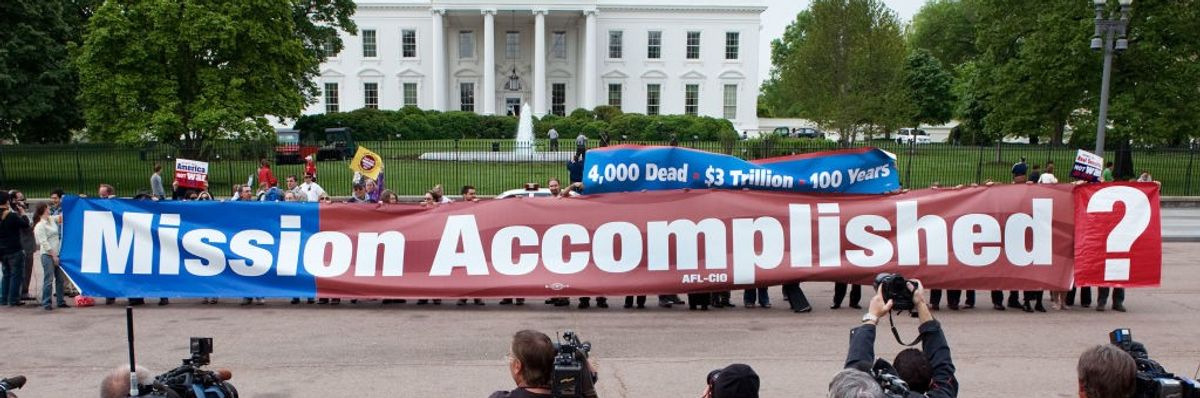
Meanwhile, the cost of the Iraq war — estimated at $ 3.5 Trillion so far — still grows for American taxpayers with no end in sight while Blackwater and Halliburton will still make a “killing” in Iraq.


Posted in Iraq0 Comments

Iraq war: make it impossible to inflict such barbarism again

NOVANEWS

The US and Britain not only bathed Iraq in blood, they promoted a sectarian war that now threatens the region

An Iraqi prisoner of war

An Iraqi prisoner of war comforts his son at a center for prisoners of war captured by the US army near Najaf in March 2003. Photograph: Jean-Marc Bouju/AP

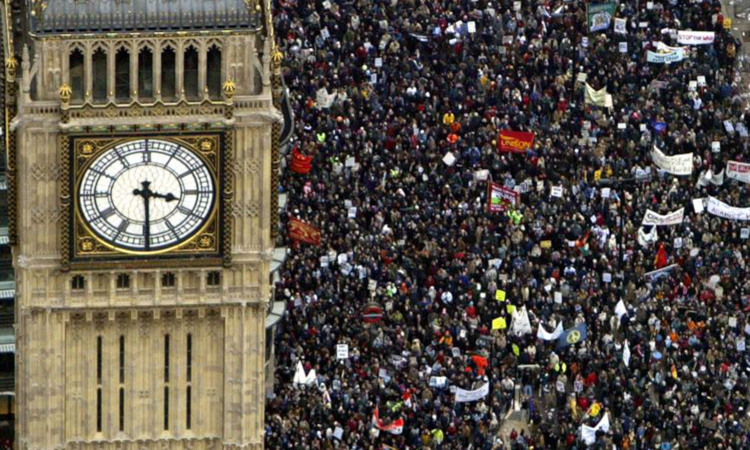
If anyone doubted what kind of Iraq has been bequeathed by a decade of US-sponsored occupation and war, today’s deadly sectarian bomb attacks around Baghdad against bus queues and markets should have set them straight. Ten years to the day after American and British troops launched an unprovoked attack on a false pretext – and more than a year since the last combat troops were withdrawn – the conflict they unleashed shows no sign of winding down.

Civilians are still being killed at a rate of at least 4,000 a year, and police at about 1,000. As in the days when US and British forces directly ran the country, torture is rampant, thousands are imprisoned without trial, and disappearances and state killings are routine.

Meanwhile power and sewage systems barely function, more than a third of adults are unemployed, state corruption has become an institutionalised kleptocracy and trade unionists are tried for calling strikes and demonstrations (the oil workers’ leader is in court in Basra on that charge tomorrow). In recent months, mass protests in Sunni areas have threatened to tip over into violence, or even renewed civil war.

The dwindling band of Iraq war enthusiasts are trying to put their best face on a gruesome record. Some have drifted off into la-la land: Labour MP Tom Harris claims Iraq is now a “relatively stable and relatively inclusive democracy”, which is more or less the direct opposite of reality.

Tony Blair – treated with media reverence but regarded by between 22% and 37% of Britons as a war criminal – accepts the cost of invasion was “very high”. But the former prime minister claims justification in the overthrow of Saddam Hussein, while insisting that a popular uprising against his regime would have triggered a worse death toll than in Syria. That avoids the fact that the US and Britain controlled Iraq’s airspace from 1991 and could have prevented aerial attacks on rebels. It also blithely ignores the scale of the bloodbath for which George Bush and he are directly responsible.

Whether either is ever held to account for it, global opinion against the Iraq war is long settled – including in Britain, the US and Iraq. The invasion was a flagrant act of aggression against a broken-backed state, regarded as illegal by the overwhelming weight of international legal opinion.

The onslaught triggered a death toll which certainly runs into hundreds, rather than tens, of thousands: estimates range from the Iraq Body Count’s minimum of 173,271 up to 2012 (acknowledged to be an underestimate) through the Iraqi government and World Health Organisation’s 223,000 and Lancet survey’s 654,965 “excess deaths in the first three years, to the ORB polling organisation’s estimate of more than a million.

The occupation was a catastrophe for Iraqis. It destroyed the country’s infrastructure, created 4 million refugees, reduced cities like Falluja to ruins – littered with depleted uranium and white phosphorus as cancer rates and birth defects multiplied – and brought al-Qaida and its sectarian terror into the country.

That wasn’t the result of mistakes and lack of planning, as the US and British elites like to tell themselves. But as with the armed resistance that mushroomed in the aftermath of the invasion, they were foreseeable and foreseen outcomes of what by any sober reckoning has been a reckless crime.

Saddam Hussein “created enormous carnage”, Blair said today – which was certainly true in the years when his regime was backed by Britain and the US. But that is exactly what Bush and he did in their war to overthrow him. The biggest improvement in Iraqis’ lives thereafter came as a result of the lifting of US and British-enforced sanctions, estimated by Unicef to have killed half a million Iraqi children in the 1990s.

Ten years on, the US still has a powerful presence in Iraq – now starting to resemble a sort of American-Iranian condominium – with thousands of military contractors, security and intelligence leverage and long-term oil contracts. But it’s a long way from the archipelago of bases and control its leaders had in mind.

Iraqi success in preventing a permanent occupation is down to resistance, armed and civil, Sunni and Shia. But that achievement was undermined by the eruption of sectarianism in the aftermath of the invasion, fostered by the occupying forces in the classic imperial divide and rule mould.

The evidence is now indisputable that this went far beyond the promotion of a sectarian political carve-up. As the Guardian reported this month, US forces led by General Petraeus himself were directly involved not only in overseeing torture centres, but also in sponsoring an El Salvador-style dirty war of sectarian death squads (known as police commando units) to undermine the resistance.

One outcome is the authoritarian Shia elite-dominated state run by Nouri al-Maliki today. His Sunni vice-president until last year, Tariq al-Hashimi – forced to leave the country and sentenced to death in absentia for allegedly ordering killings – was one of those who in his own words “collaborated” with the occupation, encouraging former resistance leaders to join Petraeus’s “awakening councils”, and now bitterly regrets it. “If I knew the result would be like this, I would never have done it,” he told me at the weekend. “I made a grave mistake.”

The sectarian virus incubated in the occupation has now spread beyond Iraq’s borders and threatens the future of states across the eastern Arab world. But the war hasn’t only been a disaster for Iraq and the region. By demonstrating the limits of US power and its inability to impose its will on peoples prepared to fight back, Iraq proved a strategic defeat for the US and its closest allies. For the British state, the retreat of its armed forces from Basra under cover of darkness, with their own record of torture and killings, was a humiliation.

There’s little prospect, given the balance of power, of those most responsible for torture and atrocities in Iraq – let alone ordering the original aggression – of facing justice, or of the reparations Iraqis deserve. But there should be a greater chance of preventing more western military intervention in the Middle East, as Blair and his friends are now pressing for in Syria and Iran.

Damn us for what we did,” a British Iraq veteran wrote today. Far better would be to make it impossible for the politicians who sent them there to unleash such barbarism again.

Posted in Iraq0 Comments

Join our mailing list

* = required field

Archives